
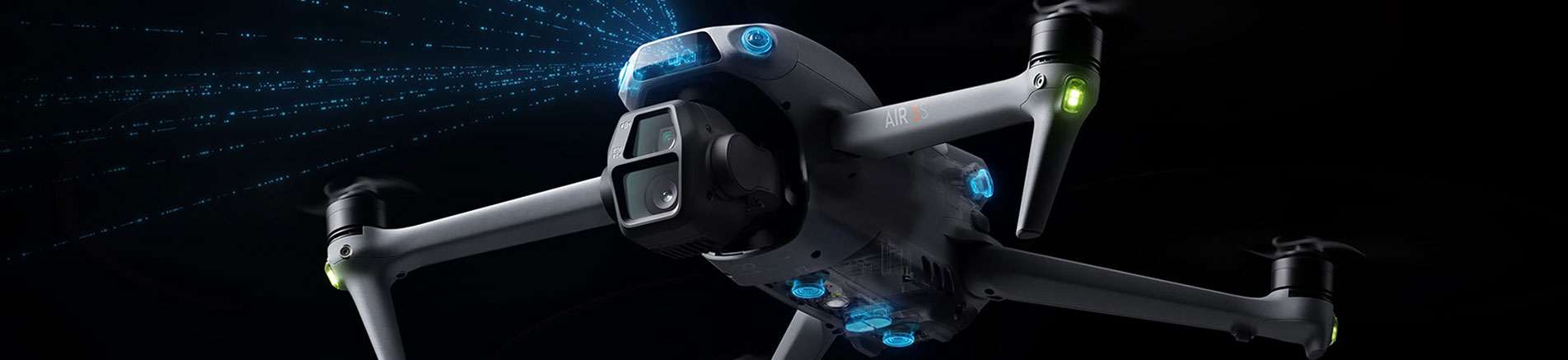
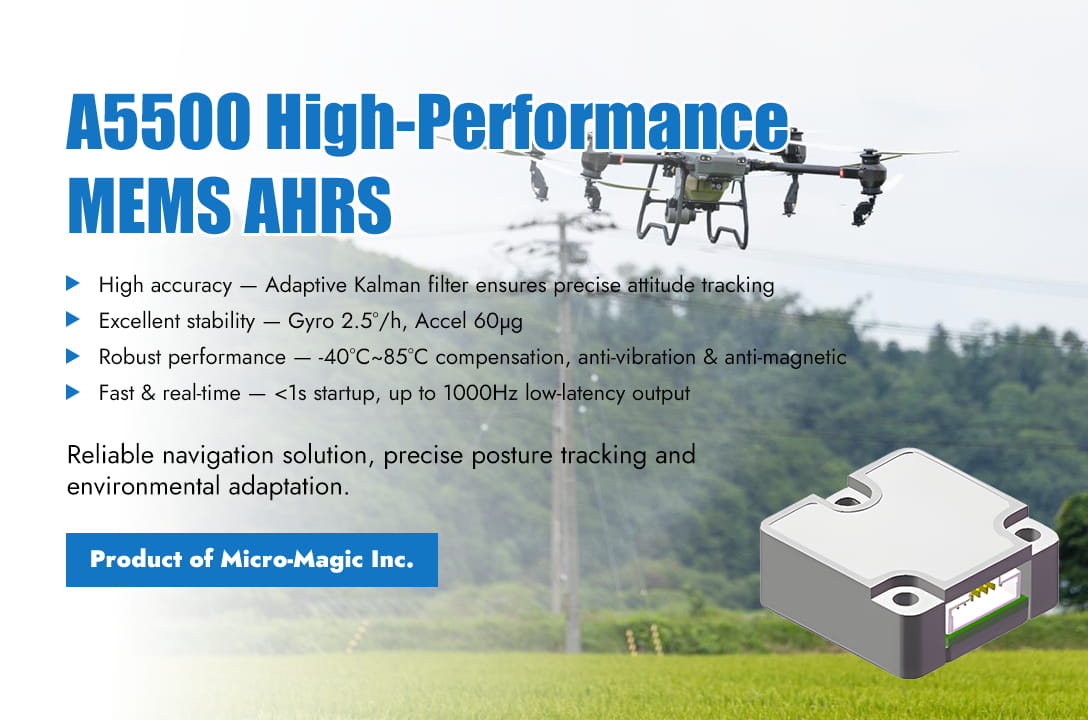
Attitude and heading reference system (AHRS) is a device that utilizes MEMS inertial sensors (accelerometers, gyroscopes) and magnetometers, combined with advanced sensor fusion algorithms (most commonly Kalman filtering and its variants), to calculate real-time attitude information (pitch angle, roll angle, yaw/heading angle) of a carrier (aircraft, vehicle, ship, robot, etc.) relative to the local horizontal plane and in the north direction. The Main Application Scenarios of AHRS 1. Application fields of aviation flight and land vehicles In the attitude stabilization and control system of unmanned aerial vehicles, the flight control system relies on real-time, high-frequency attitude data provided by AHRS to stabilize the aircraft, perform maneuvers (such as turning, climbing, descending), and maintain hovering. This is the most core application of AHRS in unmanned aerial vehicles. Meanwhile, the heading angle provided by AHRS is a key input for unmanned aerial vehicle integrated navigation systems (usually integrated with GPS, barometers, etc.), used for waypoint tracking and autonomous navigation. In the control applications of general aviation aircraft (small aircraft, helicopters), AHRS provides attitude indication and magnetic heading information on the primary flight display (PFD) for pilots. The integration of AHRS with GPS and other systems can provide more reliable and robust navigation solutions for general aviation aircraft. In the stability control of ground vehicles, AHRS is used to detect the roll angle and yaw rate of the vehicle, prevent sideslip and rollover, and provide the auto drive system with vehicle attitude information relative to the road surface for path planning, control decision-making and sensor fusion (such as fusion with camera and radar data). 1. Marine vessels and other advanced technology application fields AHRS monitors the roll and pitch angles of ships for navigation safety, cargo management, or scientific research purposes. In the stability control system of a ship, attitude feedback is provided for stabilizing devices such as anti roll fins and gyro anti roll devices. In ship autopilot/trajectory control, providing heading information is the foundation of ship autopilot. AHRS provides attitude and heading information for ground, aerial, or underwater robots during mobile robot navigation, which is crucial for autonomous movement and positioning. In a robotic arm control system, sensing the posture of the end effector or joint of the robotic arm. In AR/VR systems, the VR headset is equipped with AHRS to track changes in the user's head posture and update the virtual scene perspective. Simultaneously used to capture posture movements of body parts or props (usually requiring higher accuracy and using more professional IMUs). The Main Advantages of AHRS AHRS has the following irreplaceable advantages: → Low cost: The large-scale production of MEMS technology makes AHRS much cheaper than high-precision fiber optic or laser gyro inertial navigation systems (INS), making it widely applicable in consumer and commercial markets such as drones and automotive electronics. → Small size, light weight, low power consumption: MEMS sensors are very compact, and the entire AHRS module can be made very compact and lightweight, with relatively low power consumption, making it very suitable for platforms with limited space, weight, and power consumption (such as small drones and wearable devices). → Quick start and high dynamic response: After starting, it can quickly provide accurate attitude information within seconds to tens of seconds (depending on the convergence speed of the algorithm), without the need for long warm-up periods like mechanical gyroscopes. Capable of quickly responding to the intense maneuvering of the carrier, outputting high-frequency attitude data (usually up to 100Hz or higher), meeting the requirements of real-time control. → Easy to integrate: Typically provides standardized digital interfaces (such as UART, SPI, I2C, CAN, RS232, RS422) for easy integration with other systems (such as flight control computers, navigation computers, displays). Introduction to Related Product Performance The following are the performance indicators of the AHRS series products. Main Parameter A500 A5500 Unit Attitude angles Heading angle 0.2 0.1 ° RMS Pitch/Roll angle 0.2 0.1 ° RMS Attitude ranges Roll ±180 ±180 ° RMS Pitch ±90 ±90 ° RMS Gyroscope Measurement range ±100 ±2000 °/s Angle random walk 0.09 0.6 °/√h Zero bias stability (In-Run) 3 5.1 °/h (Allan) Accelerometer Measurement range ±10/±20/±40 ±12 g Angle random walk 0.03 0.08 (m/s)/√h Zero bias stability (In-Run) 0.03 0.06 mg Magnetometer Measurement range ±8 ±8 Gauss Conclusion AHRS, with its core characteristics of solid-state, low cost, small size, low power consumption, and fast start-up, has become a core attitude sensing device in many fields such as modern drone flight control, small aircraft avionics upgrades, vehicle stability control, ship attitude monitoring and navigation, robot navigation, and VR/AR. Although its absolute accuracy is usually lower than high-end INS systems, its excellent cost-effectiveness and environmental adaptability make it the most widely used attitude reference solution. A500 A5000 A5500
Read More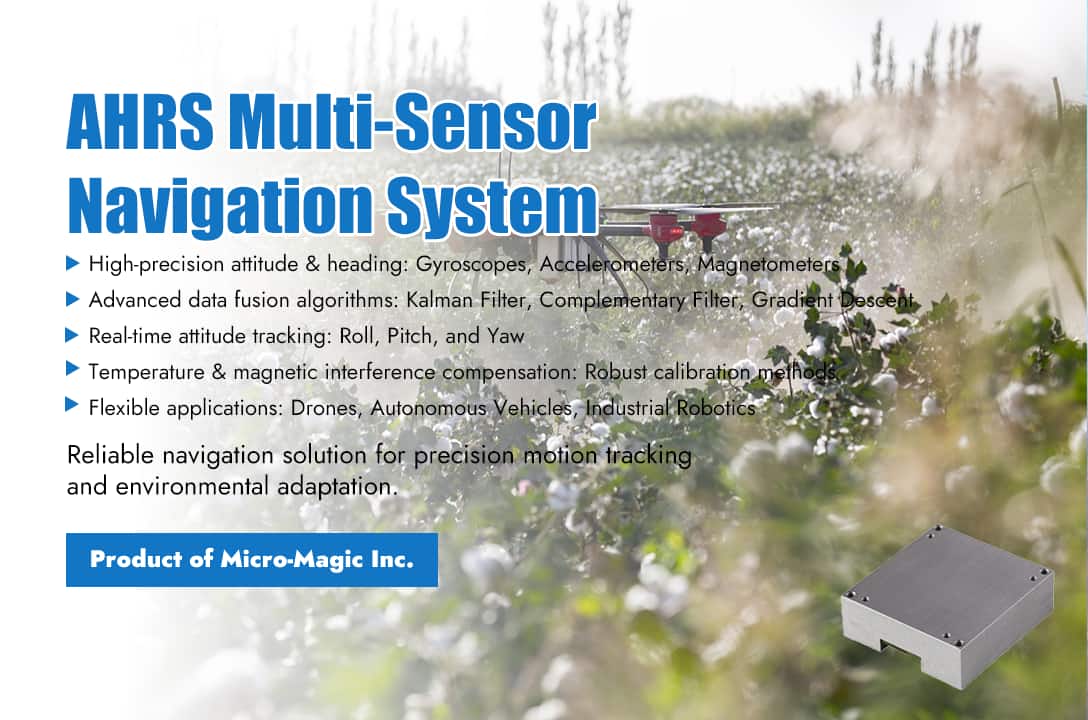
Quickly get the product information in one minute Attitude and Heading Reference System (AHRS) is a key navigation device that uses multi-sensor data fusion to real-time calculate the three-dimensional attitude (pitch angle, roll angle) and heading angle of a carrier. Its core technologies involve fields such as microelectromechanical systems (MEMS), inertial navigation, signal processing, and nonlinear optimization. This article will explore technical aspects from three dimensions: mathematical models, algorithm implementation, and error compensation. Principles and kinematic equations of AHRS The core principle of AHRS is multi-sensor data fusion, which compensates for the limitations of a single sensor through complementary sensors. 1. Sensor composition: a. Gyroscope: It measures angular velocity using the Coriolis effect and integrates it to obtain attitude changes, but there is zero bias drift (accumulated error over time). b. Accelerometer: measures specific force (gravitational acceleration+motion acceleration) and can be used for attitude calibration (roll, pitch) at static or constant speed. c. Magnetometer: measures the direction of the geomagnetic field, provides absolute heading (yaw angle), but is susceptible to hard/soft magnetic interference. d. Optional GPS: Assist in correcting position and velocity errors. 2. Kinematic equations Differential equation for carrier angular velocity and attitude update: Among them, represents quaternion multiplication and is the angular velocity measured by the gyroscope (in rad/s) The core architecture and algorithm of AHRS The core challenge of AHRS lies in how to integrate data from gyroscopes (with excellent dynamic response but drift), accelerometers (with high static accuracy but subject to motion interference), and magnetometers (providing absolute heading but susceptible to interference). The mainstream algorithms are as follows: 1. Kalman Filter Based on the state space model, the attitude is iteratively estimated through prediction (gyroscope integration) and update (accelerometer/magnetometer observation). The construction of the state vector is as follows, including attitude error angle and gyroscope bias . The residual of gravity vector measured by accelerometer and geomagnetic field measured by magnetometer are used as observation values, and the following observation equation is constructed: In covariance tuning, the noise covariance of the accelerometer is usually set to , and the noise covariance of the magnetometer is set to . 2. Complementary Filter Algorithm Weighted fusion of high-frequency gyroscope data and low-frequency accelerometer/magnetometer data. Its advantage is that it has a small computational load and is suitable for embedded systems; The disadvantage is that parameter tuning relies on experience and has limited dynamic performance. The high-frequency part uses gyroscope integration, and low frequency calibration using accelerometers/magnetometers: Time constant , usually takes 3. Gradient descent optimization algorithm There are two main gradient descent optimization algorithms. The Mahony algorithm is based on quaternion nonlinear complementary filtering and corrects gyroscope bias through a PI controller; The Madgwick algorithm optimizes quaternions directly by minimizing the error function between sensor measurements and predictions, resulting in high computational efficiency and suitability for low-power scenarios. Among them, is the convergence rate factor, with typical values ranging from 0.1 ~ 0.5 . Challenges and Countermeasures of AHRS Engineering Implementation 1. Sensor error and calibration The zero bias of the gyroscope needs to be estimated and compensated online (such as through static state initialization); Motion acceleration can disrupt the measurement of gravity direction, therefore, dynamic interference from accelerometers needs to be detected through high pass filtering or motion state detection; The influence of temperature changes on gyroscopes and accelerometers needs to be corrected by establishing a temperature compensation model; The interference of magnetometer requires hard/soft magnetic calibration (ellipse fitting or calibration field based algorithm). 2. Dynamic environmental adaptability High frequency vibration causes an increase in accelerometer noise, requiring mechanical isolation or digital filtering. When performing rapid maneuvers (such as drone rolling), the accelerometer fails and a pure gyroscope needs to work for a short period of time. 3. Real time performance and computing resources High dynamic scenarios require algorithms to complete iterations in milliseconds (such as drone control cycles <10ms). Embedded platforms such as STM32 require optimization of floating-point operations or adoption of fixed-point number processing. 4. Multi sensor synchronization and latency The collection of sensor data requires strict time synchronization, otherwise the fusion error will increase. The transmission delay of communication interfaces (such as SPI/I2C) needs to be compensated. 5. Initial alignment and robustness The system needs to converge quickly during startup (such as by initializing the accelerometer/magnetometer in a stationary state). The system design requires robust design against outliers (such as instantaneous interference from magnetometers). Future development direction a. Deep learning assisted fusion: using neural networks to model complex errors and nonlinear characteristics. b. Multi source fusion enhancement: Combining vision (VIO), GNSS, or barometer to improve reliability in complex environments. c. Progress in MEMS technology: Higher precision low-noise gyroscopes (such as MEMS optical gyroscopes) will reduce algorithm burden. d. Edge computing optimization: algorithm lightweight for embedded AI chips (such as ARM Cortex-M7). Conclusion The technological evolution of AHRS is essentially a deep interweaving of mathematics, physics, and engineering practice. From real-time solving of quaternion differential equations to noise suppression of MEMS sensors, every technical detail directly affects the final performance of the system. With the improvement of edge computing capability and the practicality of high-precision sensors, the next generation of AHRS will achieve nanometer level angular vibration perception and fully autonomous anti-interference capability, giving unmanned systems space cognitive accuracy beyond human beings. A5500 Whatever you needs, Micro-Magic is at your side. U6488 Whatever you needs, Micro-Magic is at your side. A5000 Whatever you needs, Micro-Magic is at your side.
Read Moreleave a message
Scan to Wechat :