

A single navigation sensor cannot simultaneously meet requirements for accuracy, reliability, and continuity across all operating conditions. While Inertial Navigation Systems (INS) offer the advantages of full autonomy and high output rates, their errors grow without bound over time; conversely, Global Navigation Satellite Systems (GNSS) provide a stable, long-term absolute position reference but are susceptible to signal blockage and interference.
This gives rise to the core concept of integrated navigation systems: using a computer as the central hub to synthesize and mathematically optimize data from multiple navigation sensors, thereby achieving "complementary strengths and synergistic performance." Building on this, redundant design addresses a critical issue in functional safety—ensuring the system maintains normal navigation capabilities even when a specific sensor malfunctions.
Modern multi-mode integrated navigation systems commonly employ the Federated Kalman Filter architecture. Positioned between centralized and fully decentralized filtering, this structure strikes a balance between optimality and fault tolerance.
The basic structure of a federated filter consists of a master filter and N sub-filters. Each sub-filter independently processes observation data from a sensor subsystem, while the master filter is responsible for the globally optimal fusion of the local estimates from the sub-filters.
Core Fusion Formula:
Let $\hat{X}_i$ be the state estimate and $P_{ii}$ be the estimation error covariance of the $i$-th sub-filter. If the local estimates are mutually uncorrelated, the globally optimal estimate is:
The meaning of this formula is intuitive: sub-filters with lower estimation accuracy (indicated by a larger $P_{ii}$) are assigned lower weights in the global fusion process, thereby achieving dynamic weighting based on the principle of "trusting the most accurate."
Information Allocation Principle
The federated filter distributes the total system information among the sub-filters and the master filter using information allocation coefficients Bi
Here, Q represents the system process noise covariance matrix. The information allocation strategy determines the trade-off between system accuracy and fault tolerance. A comparison of four typical operating modes is presented below:
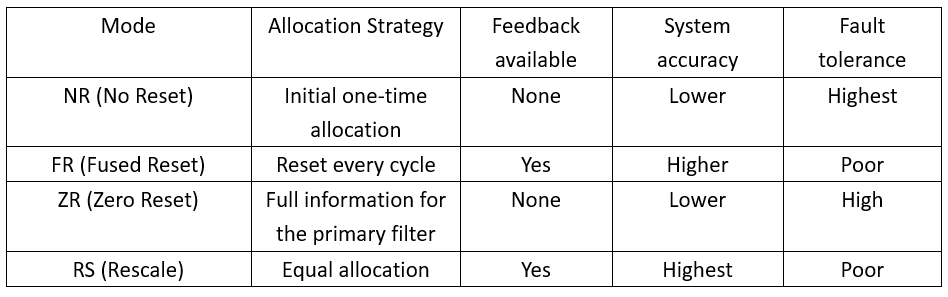
Due to the mutual isolation of the sub-filters in the NR mode, faults do not cause cross-contamination; consequently, it offers the highest fault tolerance and is best suited for fault detection and isolation.
The redundancy design of integrated navigation systems can be categorized into three levels:
(1) Component-level redundancy: Configuring multiple IMUs or multi-antenna GNSS receivers. Multi-IMU redundancy mitigates the impact of inertial drift; experiments show that a federated filtering architecture combined with multi-IMU redundancy maintains a positioning accuracy of approximately 1 meter during total GNSS failure, reducing errors by over 40% compared to single-IMU solutions.
(2) System-level redundancy: Integrating heterogeneous sensors (e.g., INS, GNSS, odometer, and vision) to form a triple or multi-redundant navigation architecture. When GNSS signals fail—such as in tunnels or urban canyons—odometry and vision complement the INS, ensuring continuous, high-precision navigation output.
(3) Information redundancy: A single sensor provides multiple types of observation data. For instance, GNSS can simultaneously output pseudorange, pseudorange rate, and carrier phase; raw multi-beam data from an LDV (Laser Doppler Velocimeter) can serve as redundant observations directly within a tightly coupled filtering framework.
The value of redundancy design lies in the system's ability to respond to faults. Typical mechanisms include:
Cross-voting: Voting among multiple redundant solution outputs to select the most consistent result and isolate anomalous observations that deviate significantly.
Residual Chi-square test: Monitoring the statistical properties of the filter innovation (residual) to determine if observations are anomalous.
LOF (Local Outlier Factor) detection: More sensitive to nonlinear scenarios and complex outliers; it can also detect violations of dynamic constraints (such as the zero-sideslip assumption).
A typical redundancy architecture for vehicle-based integrated navigation systems can be summarized as a GNSS/INS/OD (Odometer) triple-redundancy configuration. By deeply integrating vehicle odometer data, the system maintains continuous, high-precision navigation output even in GNSS-denied environments and enables seamless switching between various operating modes.
The overall architecture of the multi-mode integrated navigation system utilizes federated filtering as the core fusion mechanism and redundant design to ensure reliability. The systems engineering philosophy underpinning this combination can be summarized as follows: independent optimal estimation by individual sensors, globally optimal fusion via a master filter, and rapid fault isolation and system reconfiguration. This architecture achieves a balance among accuracy, reliability, and environmental adaptability, serving as a core technological foundation for fields such as autonomous driving, unmanned aerial vehicles (UAVs), and marine navigation.
leave a message
Scan to Wechat :