
A single navigation source struggles to meet the requirements for full operational coverage: GNSS fails underwater or in urban canyons; DVL is limited by bottom-tracking range; odometry suffers from wheel slip and scale factor errors; and vision-based systems degrade in low-texture environments or under varying lighting conditions. The core concept of multi-source fusion lies in leveraging the complementary characteristics of various sensors to achieve redundancy and fault tolerance through optimal estimation theory. This paper systematically analyzes four typical integrated navigation modes based on two dimensions: coupling depth and information complementarity.
**Classification of Coupling Depth**
Multi-source fusion can be categorized into three levels based on the depth of information integration:
* **Loose coupling** represents the lowest level of coupling, where subsystems perform independent calculations, and a master filter fuses navigation parameters such as position and velocity. Its advantages include low computational load and simple fault isolation; however, accuracy loss arises primarily from the independent nature of the subsystem calculations.
* **Tight coupling** elevates observation to the level of raw measurements; raw data from the IMU and DVL (or vision sensors) are directly involved in a joint estimation process, utilizing the temporal correlation of sensor error characteristics to achieve superior estimation.
* **Deep coupling** goes a step further by incorporating raw signals from certain sensors into the IMU's closed-loop control, establishing direct feedback in the measurement domain; this represents the highest level of coupling, enabling ultimate precision and maximum robustness.
**Principles of Four Integrated Navigation Modes**
(1) **INS/DVL Integration**
The DVL measures the vehicle's 3D velocity relative to the seabed (or water layer) using the Doppler effect. INS/DVL integration is essentially a Kalman filtering process based on velocity observations: DVL velocity measurements serve as external observations to correct INS velocity errors, thereby suppressing position drift. The state equations and observation equations can be expressed as follows:


Here, the state vector $x$ includes attitude, velocity, and position errors, as well as gyro and accelerometer biases, while $H$ is the velocity observation matrix. DVL errors do not accumulate over time, effectively constraining the error growth of the inertial navigation system.
INS/Odometer Integration
The odometer measures travel distance via wheel pulses or encoders; like the DVL, it falls under the category of velocity observation. However, its constraint is typically limited to forward velocity, necessitating the use of non-holonomic constraints (NHC)—which assume the vehicle neither sideslips nor bounces (i.e., lateral and vertical velocities are zero). Its observation model can be expressed as:
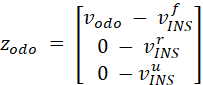
Key issues associated with odometry include scale factor errors and wheel-slip errors; the former can be compensated for through online calibration, while the latter requires velocity resetting at standstill intervals using Zero-Velocity Update (ZUPT) techniques.
(3) INS/Vision Integration
Visual SLAM/odometry recovers changes in camera pose through feature point extraction and inter-frame matching, with an observation model that can be described by epipolar geometry constraints:
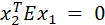
Here, E = t∧R is the essential matrix, where R and t represent the relative rotation and translation between two frames, forming a nonlinear observation of the inertial navigation system's attitude and position:
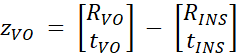
Vision provides critical positional constraints in GNSS-denied environments (such as indoors or near the seabed), achieving centimeter-level accuracy in texture-rich areas. Tightly coupled visual-inertial systems typically employ sliding-window optimization (e.g., MSCKF) to jointly optimize visual reprojection errors and IMU pre-integration factors, yielding an order-of-magnitude improvement in accuracy compared to loosely coupled systems.
(4) Multi-source fusion of INS, vision, DVL, and odometry
When all four sensors are integrated, the system establishes a highly redundant navigation architecture. The objective function for optimization is the weighted sum of the residuals from each sensor:

The covariance matrix Σ is central to determining fusion weights: the smaller the covariance (indicating lower uncertainty), the higher the weight assigned to the sensor. The DVL carries the highest weight when bottom-tracking is valid; odometry ranks second on smooth terrain; and vision provides lateral constraints in areas rich in visual texture.
A Fault Detection and Isolation (FDI) mechanism monitors observation sources in real-time for anomalies using Chi-square or residual tests. If DVL bottom-tracking fails, the system automatically degrades to an INS/odometry/vision fusion mode; if vision degrades, it switches to INS/DVL/odometry; if only INS and odometry remain, it reverts to a pure INS mode constrained by Non-Holonomic Constraints (NHC). A heterogeneous redundant design ensures navigation continuity despite single-point failures, enabling seamless coverage across diverse operational scenarios—from shallow and deep water to near-bottom underwater environments.
Conclusion
Multi-sensor integrated navigation is not merely about increasing the number of sensors; rather, it relies on the judicious selection of coupling depth and the precise definition of covariance matrices to achieve complementary sensor performance. While deeper coupling offers higher potential accuracy, it also increases computational complexity and engineering implementation challenges; therefore, the optimal fusion architecture should be selected based on specific mission requirements.
leave a message
Scan to Wechat :