
The marine environment poses severe challenges to inertial navigation systems (INS): salt spray corrosion, high humidity condensation, continuous swaying motion, and multi-dimensional vibration all directly affect the system's accuracy and reliability. If the INS cannot effectively cope with these environmental stresses, alignment failures, accuracy degradation, and even hardware damage will occur. Therefore, adaptive design is the core technological barrier that distinguishes marine-grade INS from general-purpose products.
Salt Spray and High Humidity Environment Protection Design
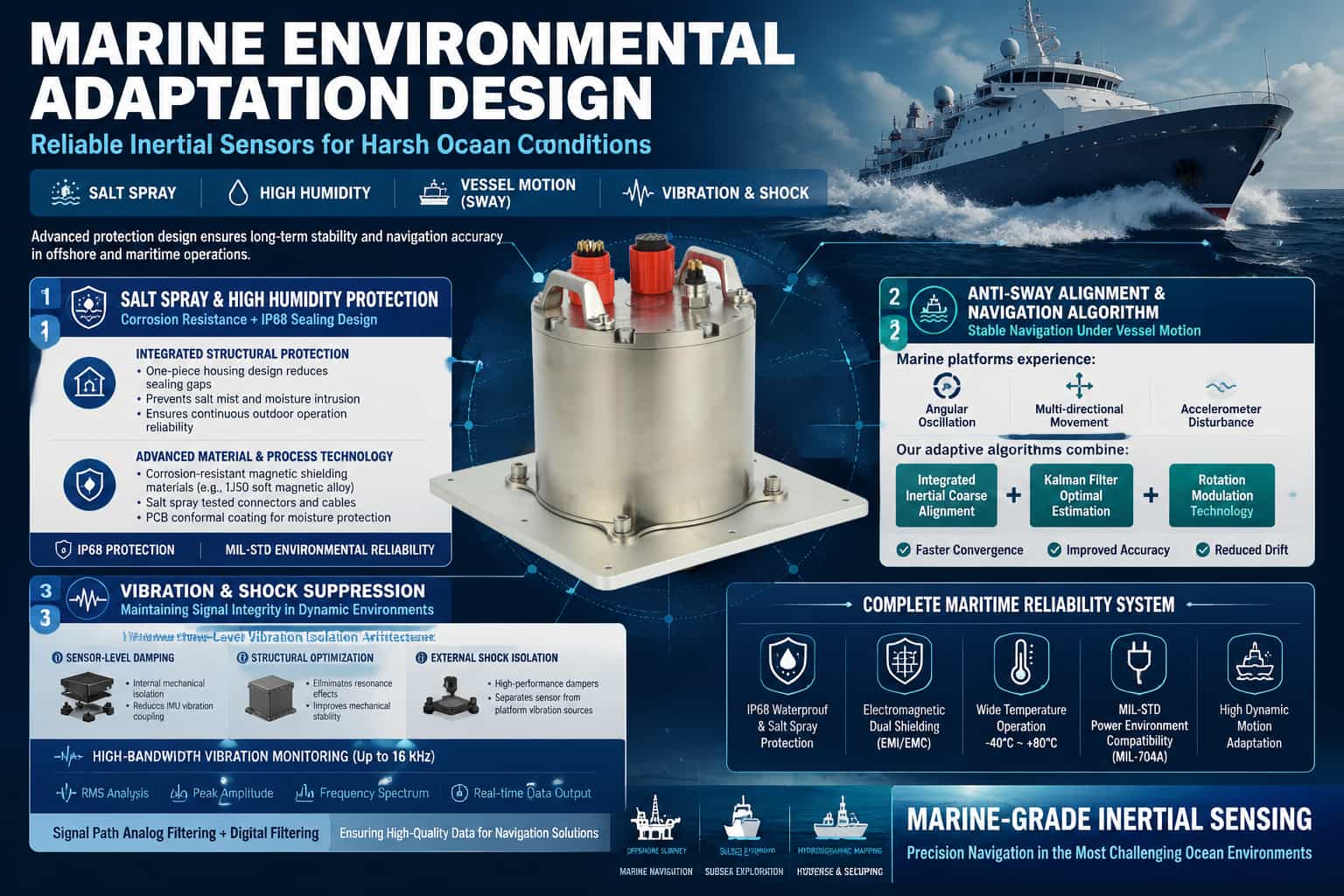
Chloride ions in salt spray are highly corrosive to metal structural components and electrical connections, while high humidity environments can lead to decreased insulation performance and signal crosstalk. Effective protection strategies should be developed from two aspects: structural sealing and material selection.
Integrated structural design reduces assembly gaps and the number of connectors. A one-piece molded shell can fundamentally block the salt spray intrusion path, and combined with positioning grooves and sealing gasket structures, ensures continuous protection during long-term outdoor operations.
Regarding material and process selection, the fiber optic ring frame and cover should use magnetic shielding materials (such as 1J50 soft magnetic alloy) to achieve magnetic protection while also ensuring corrosion resistance. Connectors and cables must meet salt spray testing standards, and circuit boards must undergo a three-proof coating process. IP68 protection, conforming to MIL-STD standards, is currently the industry's effective solution for high-humidity salt spray environments.
Alignment and Navigation Algorithms under Swaying Conditions
Under swaying conditions, the initial alignment of the inertial navigation system (INS) faces two major disturbances: angular sway (periodic attitude changes) and linear vibration (accelerometer output fluctuations). Traditional static base alignment algorithms struggle to converge under these conditions.
Anti-sway alignment methods employ an integral inertial frame coarse alignment strategy, utilizing attitude updates to eliminate the influence of angular sway and weakening linear vibration interference through force integration. Based on this, feedback-corrected Kalman filtering is used for fine alignment optimal estimation. Experiments show that this method significantly improves both horizontal and vertical heading accuracy under swaying conditions compared to traditional rotation modulation schemes.
Rotation modulation technology is another effective means of suppressing gyro scaling factor errors. By periodically rotating the IMU, constant drift is modulated into a periodically changing signal, which cancels each other out during integration, thereby reducing the long-term impact of swaying on heading accuracy.
Vibration Suppression and Shock Resistance Design
Vibration affects inertial navigation system (INS) accuracy through two mechanisms: first, mechanical resonance causes IMU output distortion; second, high-frequency vibration couples into the gyroscope and accelerometer measurement channels, forming spurious signals.
A three-stage vibration reduction architecture is the current mainstream design approach: the first stage achieves internal damping isolation at the IMU sensor level; the second stage eliminates resonant frequencies through shell structure optimization; and the third stage uses external dampers to physically separate the equipment from the carrier structure. Some high-end systems also integrate high-bandwidth (up to 16kHz) vibration monitoring tools, outputting RMS, peak amplitude, and frequency for each frequency band in real time, providing data support for structural optimization.
Analog filtering in the signal pipeline can pre-attenuate vibration noise at the front-end hardware level, and, in conjunction with digital filtering algorithms, ensures the signal quality entering the calculation stage.
Comprehensive Protection System
In addition to the above-mentioned specialized designs, mature maritime INS systems also need to consider: power environment adaptability (meeting MIL-704A standards), electromagnetic double-layer shielding (to cope with interference from shipboard radar and communication equipment), and wide temperature range operation capability (-40℃~80℃). These measures together constitute a complete design system for adaptability to harsh environments, which is the fundamental guarantee for the inertial navigation system to maintain mapping-level accuracy under marine conditions.
leave a message
Scan to Wechat :