
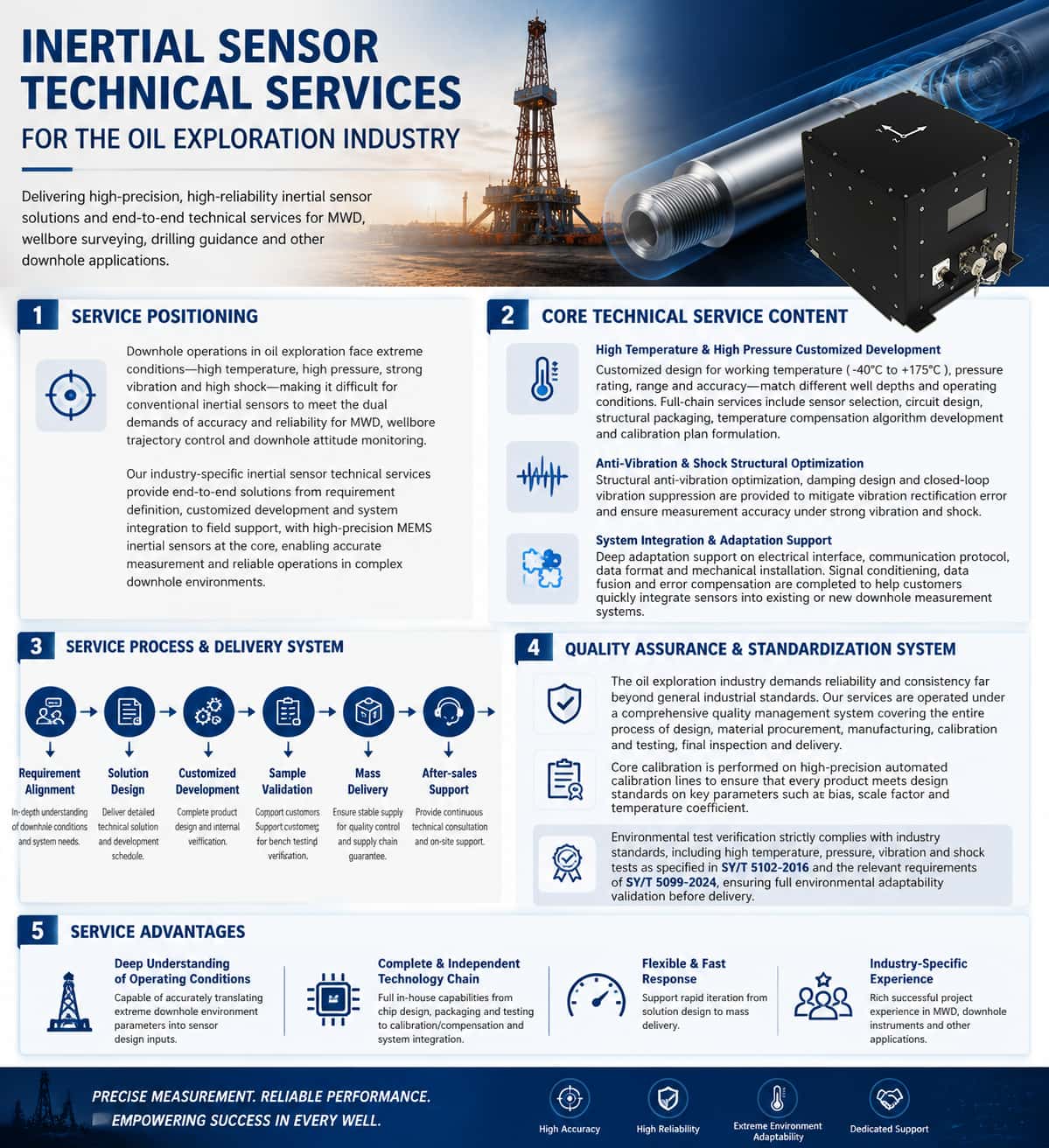
The oil and gas industry places unique and rigorous demands on inertial sensors. Whether for Measurement While Drilling (MWD), wellbore trajectory control, or downhole attitude monitoring, IMU sensors perform indispensable core measurement functions. However, downhole environments are characterized by extreme conditions—including high temperatures, high pressures, intense vibrations, and severe shocks—while varying well conditions, depths, and bottom-hole assemblies (BHAs) impose distinct requirements regarding sensor performance, dimensions, interfaces, and operating temperature ranges. Standard off-the-shelf products often fail to fully meet specific operational needs, making customized development the norm within the inertial sensor supply chain for this industry.
Meanwhile, the lifecycle of oil and gas exploration equipment—from R&D to mass production—follows a typical trajectory: customized development, small-batch prototyping, and volume supply. This process reflects both the industry's uncompromising pursuit of product quality and reliability and the unique role inertial sensors play as critical components within supply chain management. These three stages are detailed below.
1. Customized Development: Application-Driven, Deeply Tailored Solutions
Customized development of inertial sensors for the oil and gas industry essentially involves translating the specific downhole operational requirements of the client into engineered sensor solutions.
Requirement Alignment and Solution Design. Customized development begins with a deep understanding of the client's application scenario—including well depth and temperature ranges, downhole pressure ratings, drill string vibration and shock profiles, installation space and interface constraints, measurement accuracy requirements, and communication protocols and data formats. Sensor manufacturers must be capable of rapidly responding to customization requests, particularly for specialized needs such as wide measurement ranges, vibration resistance, high-shock tolerance, and extended temperature ranges. The design phase encompasses system-level tasks—such as sensor selection, circuit design, structural design, thermal management, and vibration-resistant design—culminating in the delivery of a detailed technical proposal and development timeline.
Independent Control of Core Technologies. The customized development of high-performance inertial sensors involves multiple technical stages, including structural design, ASIC circuit design, packaging and testing, and calibration and compensation. Possessing fully proprietary structural architectures and rapid customization design methodologies serves as the technical foundation for quickly meeting client-specific requirements. Meanwhile, autonomous and controllable packaging and testing lines, along with automated batch calibration assembly lines, lay the foundation for consistency, yield rates, and production capacity during the customization phase, paving the way for subsequent mass production.
Design Verification and Iteration. Customized development is not a one-off delivery but a closed-loop process involving multiple rounds of design, verification, and iteration. Sensor performance, structure, and algorithms are continuously optimized based on test data and field application feedback from the customer until all operational requirements are fully met.
2. Small-Batch Prototyping: A Bridge Between Design and Physical Product
Small-batch prototyping is a critical link connecting customized design with mass production; its core value lies in "verifying the highest risks at the lowest cost."
Purpose and Scope of Prototyping. Small-batch prototyping typically involves producing a limited number of units (ranging from a few to several dozen) prior to formal mass production. These samples are used by customers for integration testing, downhole field verification, and system-level commissioning. The prototyping phase entails completing the full assembly, calibration, testing, and burn-in processes to ensure the samples accurately represent the performance standards of the final mass-produced units. For downhole oil and gas applications, prototypes must also undergo environmental reliability testing, such as high-temperature/high-pressure tests and vibration/shock tests.
Rapid Iteration and Engineering Optimization. The small-batch prototyping phase often involves design fine-tuning and optimization—such as minor structural dimension adjustments, temperature compensation algorithm tweaks, or changes to interface definitions. The ability to respond quickly during this stage directly determines the project's overall timeline. Manufacturers with comprehensive R&D, production, and testing systems can ensure seamless, rapid transitions from conceptual design and sample testing to volume supply.
Transition Management from Prototyping to Mass Production. Small-batch prototyping serves not only as technical verification but also as a trial run for production processes. Small-batch production allows for the early identification of potential bottlenecks in manufacturing, testing, and the supply chain, ensuring thorough preparation for subsequent volume supply.
3. Volume Supply: Quality Systems and Supply Chain Assurance
Volume supply represents the final delivery stage of customized development and serves as the ultimate test of an inertial sensor supplier's comprehensive capabilities within the oil and gas industry.
Quality Management System. The oil and gas industry imposes quality management system requirements on suppliers that far exceed those of general industrial sectors. API Q1 is a quality management system standard specific to the oil and gas industry, introduced by the American Petroleum Institute (API); it is more rigorous than ISO 9001. The API Q1 specification covers the entire process—from design and production to the supply chain—requiring organizations to demonstrate their ability to consistently provide reliable products. For inertial sensor manufacturers, establishing and operating an API Q1 quality management system represents a pivotal leap from merely being "capable of manufacturing" to "delivering reliable performance."
Supply Chain Management. During the mass supply phase, sensor manufacturers must establish stable raw material supply channels, controllable outsourced processing resources, and efficient logistics and delivery systems. Ancillary materials—such as specific inertial sensors, chassis, housings, PCBs, and various electronic components—are often procured externally, necessitating strict supplier qualification audits and quality control. Core processes—including high/low-temperature sensor calibration, error compensation, performance testing, and assembly/debugging—are performed independently by the manufacturer, leveraging their own technical strengths.
Batch Calibration and Consistency Control. The accuracy of inertial sensors depends not only on the chip itself but, more importantly, on the precision of calibration and compensation. During mass supply, manufacturers require fully in-house developed automated batch calibration lines. By combining proprietary equipment structures and fixtures with optimized calibration algorithms and communication architectures, they can ensure that every product meets performance standards while achieving high-volume output. The consistency and repeatability of mass-produced products regarding key metrics—such as bias, scale factor, and temperature coefficients—serve as critical benchmarks for evaluating mass supply capabilities.
Summary
The lifecycle of inertial sensors for the oil and gas industry—spanning custom development, small-batch prototyping, and mass supply—forms a complete value chain connecting market demands to finished products. Custom development translates downhole operating conditions into product specifications; small-batch prototyping mitigates technical risks through physical verification; and mass supply relies on quality management systems and supply chain capabilities to ensure reliable delivery. For manufacturers, possessing both robust technical expertise and comprehensive service capabilities is essential; these factors constitute the industry's entry threshold and core competitiveness.
leave a message
Scan to Wechat :