
I. Introduction
In downhole operations such as oil drilling and geological exploration, Inertial Measurement Units (IMUs) perform core functions including wellbore trajectory control, Measurement While Drilling (MWD), attitude determination, and navigation/positioning. However, the downhole environment is a "purgatory" for sensors: temperatures can exceed 150°C or even 200°C, pressures surpass 100 MPa, and the drill string is subjected to continuous, intense vibration and high-impact loads. In such environments, conventional IMU sensors are highly susceptible to accuracy drift, reduced service life, and even total failure. Therefore, defining the rigorous technical specifications for IMU sensors operating in high-temperature, high-pressure, and high-vibration downhole environments is crucial for ensuring the safety and accuracy of drilling operations.
The technical specifications for downhole IMU sensors can be categorized into six key dimensions: temperature adaptability, vibration and shock tolerance, accuracy and stability, packaging and dimensional constraints, electrical and power characteristics, and operational life and reliability. These are detailed below.
II. Temperature Adaptability Specifications
Temperature represents the most severe challenge posed by the downhole environment to IMU sensors. The global geothermal gradient is generally 25°C per kilometer of depth; in ultra-deep wells, bottom-hole temperatures often exceed 150°C. Consequently, the operating temperature range is a primary technical specification.
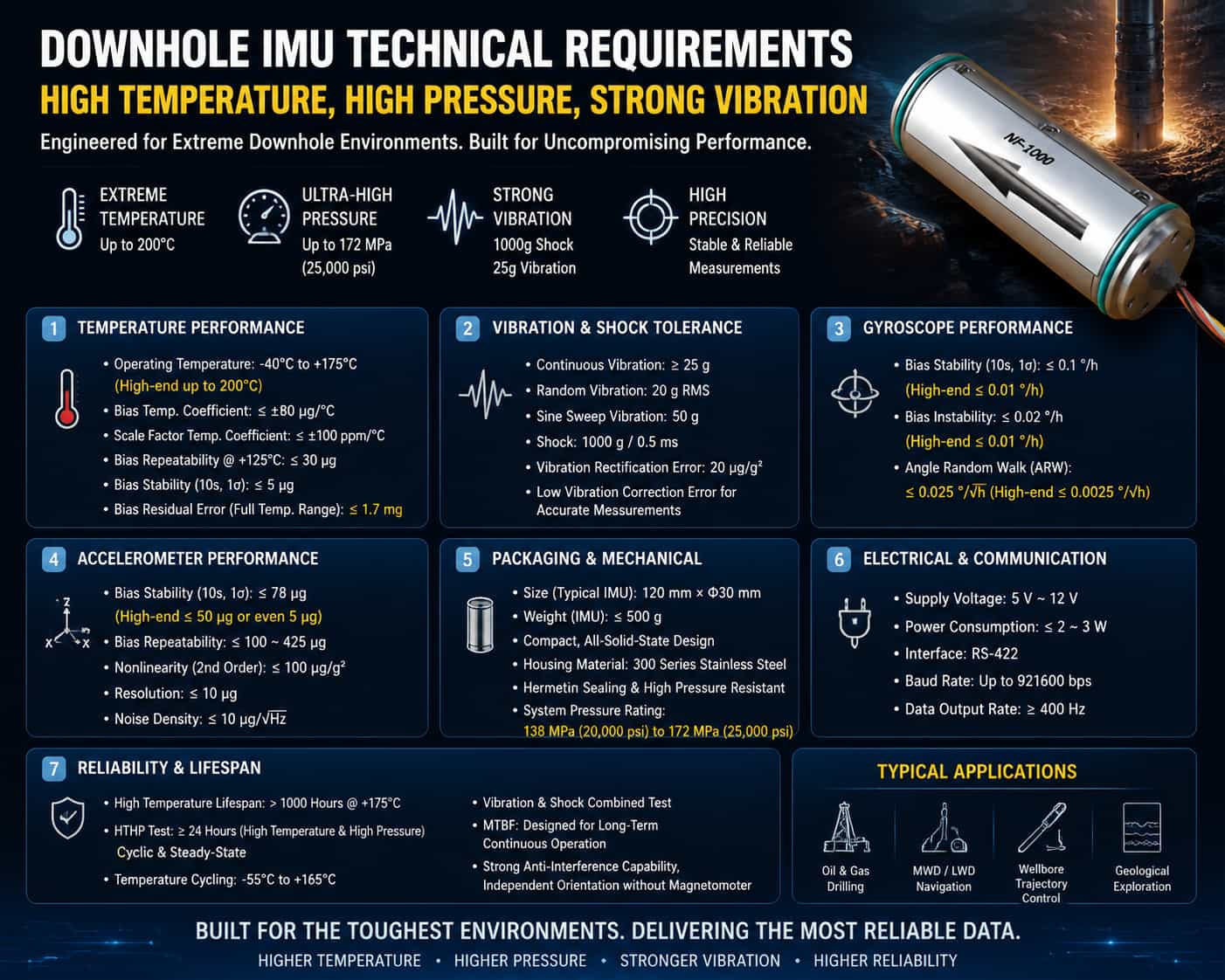
Operating Temperature Range: Downhole IMU sensors typically require an operating temperature range of -40°C to +125°C, while high-end products must withstand -40°C to +175°C or higher. Some sensors designed for ultra-deep wells can already tolerate extreme temperatures of 180°C to 200°C. The lower limit of the operating temperature range cannot be overlooked either, as equipment must withstand low temperatures during operations in cold regions or winter conditions.
Full-Temperature-Range Compensation and Temperature Stability: Merely having the capability to operate across a wide temperature range is insufficient to meet accuracy requirements. Sensors must undergo precision compensation across the entire temperature range to ensure low drift and high repeatability despite extreme temperature fluctuations. Key specifications include: the bias temperature coefficient typically needs to be controlled within ±80 μg/°C, and the scale factor temperature coefficient within ±100 ppm/°C. In a high-temperature environment of +125°C, the accelerometer's bias repeatability must be controlled within 30 μg, and its bias stability (10-second 1σ) must be less than 5 μg. Residual bias error across the temperature range is a key parameter for assessing temperature adaptability; high-end products can keep this within 1.7 mg.
III. Vibration and Shock Tolerance Specifications
During rotary drilling, the downhole drill string is subjected to continuous wide-band random vibration and instantaneous, intense shocks caused by the drill bit breaking rock. This represents the second major challenge for IMU sensors.
Continuous vibration tolerance: Sensors must withstand continuous vibration environments, typically requiring tolerance for continuous vibration exceeding 25g (gravitational acceleration). Under random vibration conditions, some high-performance sensors have successfully undergone combined testing involving 20g RMS random vibration and 50g sinusoidal swept-sine vibration.
Instantaneous shock tolerance: Drill bit impacts generate extremely high peak instantaneous accelerations; sensors must withstand high-intensity shocks in the range of 1000g/0.5ms. This specification directly determines the sensor's survivability under harsh operating conditions.
Vibration suppression capability: Beyond merely "withstanding" vibration, sensors must also "suppress" the impact of vibration on measurement accuracy. Vibration rectification error is a critical factor; advanced closed-loop architectures can reduce this error tenfold, achieving a vibration suppression capability of 20 μg/g². Low vibration rectification error ensures that true gravity and angular velocity signals can be clearly extracted amidst the complex vibrations of the drill string.
IV. Accuracy and Stability Specifications
While meeting environmental adaptability requirements, IMU sensors must also possess sufficient measurement accuracy; otherwise, attitude determination and trajectory control would be meaningless.
Gyroscope specifications: Gyro bias stability is a core parameter for measuring gyroscope accuracy. Requirements are typically below 0.1°/h (10-second 1σ), with high-end products achieving 0.01°/h or even lower. Bias instability requirements are below 0.02°/h, with some products achieving levels within 0.01°/h. Angle Random Walk (ARW) is a critical metric for gyro noise levels; requirements start as low as 0.025°/√h, with high-end products achieving 0.0025°/√h.
Accelerometer specifications: Bias stability requirements are typically below 78 μg, with high-performance products achieving less than 50 μg or even 5 μg (10-second, 1σ). Bias repeatability must be controlled within the 100 μg to 425 μg range. The second-order nonlinearity coefficient must be less than 100 μg/g² to ensure linearity in acceleration measurements across a wide dynamic range. Regarding resolution, high-performance accelerometers can achieve levels below 10 μg. Noise density, a key indicator of the accelerometer's noise floor, is typically required to be below 10 μg/√Hz.
Long-term stability: Given that downhole operations can span weeks or even months, the long-term stability of sensor bias and scale factor is crucial. The combined monthly repeatability for bias must be controlled within 150 μg, and for scale factor, within 150 ppm. The combined monthly repeatability for the nonlinearity coefficient must be controlled within ±40 μg/g².
V. Packaging and Dimensional Constraints
Downhole space is extremely limited; IMU sensors must meet strict miniaturization and packaging requirements.
Physical dimensions: Sensors require a compact design to fit into downhole tools with limited diameters. A typical high-performance IMU measures approximately 120 mm × Φ30 mm. Discrete components, such as accelerometers, require even greater miniaturization, with typical dimensions as small as Φ18.2 × 16 mm.
Weight: Lightweight design is a standard requirement for downhole instruments. The weight of a complete IMU is typically kept under 500 g, while discrete accelerometers can weigh as little as 25 g.
Structural design: An all-solid-state design with no moving parts is the preferred choice for downhole IMUs, significantly enhancing reliability in environments subject to intense vibration and high shock. An integrated cylindrical design facilitates embedding into downhole tools without altering existing equipment layouts. The housing must be constructed from corrosion-resistant, high-strength materials, such as 300-series stainless steel. Sealing and Pressure Resistance: As a core component of downhole instruments, the IMU sensor requires packaging that meets high-pressure sealing standards. Although the IMU is typically housed within a pressure-resistant tool string, its packaging design must still ensure airtight integrity and insulation performance in high-temperature, high-pressure environments. System-level pressure resistance specifications typically require ratings of 138 MPa (20,000 psi) or even 172 MPa (25,000 psi).
VI. Electrical and Power Consumption Specifications
Downhole power supply conditions are limited; therefore, the electrical characteristics of the IMU sensor directly impact system feasibility and operational duration.
Supply Voltage: Must support a wide input voltage range to accommodate unstable downhole power conditions; typical requirements range from 5V to 12V.
Power Consumption: Low power consumption is a critical requirement. The power consumption of the complete IMU unit generally needs to be kept within 2W to 3W. Low power consumption not only alleviates the load on the downhole power supply system but also minimizes the sensor's own temperature rise, facilitating thermal management in high-temperature environments.
Communication Interface: Must be equipped with a bus interface suitable for long-distance downhole transmission; RS-422 is a common choice. The communication baud rate must meet real-time requirements, typically reaching up to 921,600 bps. The data refresh rate must satisfy the control system's real-time needs, with a typical value of no less than 400 Hz.
VII. Operational Life and Reliability Specifications
Downhole operations cannot be arbitrarily interrupted; therefore, the IMU sensor must possess sufficient operational life and reliability.
High-Temperature Operational Life: The sensor must be capable of continuous operation for several thousand hours at its rated operating temperature. At the extreme operating temperature of +175°C, a service life exceeding 1,000 hours is required.
Reliability Testing: The sensor must pass a series of environmental reliability tests, including High-Temperature High-Pressure (HTHP) cycling and steady-state tests (typically ≥24 hours), temperature cycling tests (e.g., -55°C to +165°C), and combined high-temperature vibration tests. Mean Time Between Failures (MTBF) serves as a quantitative measure of reliability and must meet the requirements for continuous downhole operation. Anti-interference capability: In downhole environments characterized by strong magnetic interference, the IMU must possess the ability to orient itself autonomously—independent of the Earth's magnetic field—thereby overcoming the failure issues faced by traditional magnetic compasses in ferromagnetic environments (such as inside steel casings).
Conclusion
The technical specifications for downhole IMUs—designed to withstand high temperatures, high pressures, and intense vibrations—encompass six key dimensions: temperature adaptability, tolerance to vibration and shock, measurement accuracy and stability, package size, electrical power consumption, and operational lifespan/reliability. These parameters are interconnected and mutually constraining. Industry trends indicate a continuous rise in upper operating temperature limits—moving from 125°C toward 150°C, 175°C, and even 200°C—alongside ongoing improvements in vibration suppression and measurement accuracy, as well as optimized miniaturization and low-power designs. These technological advancements are driving the evolution of downhole IMU sensors toward higher temperature and vibration tolerance, greater accuracy, and extended service lives, thereby providing increasingly robust technical support for the exploration and development of deep-earth oil and gas resources.
leave a message
Scan to Wechat :