In the era of rapid development in industrial automation and the Internet of Things (IoT), the "communication capability" between sensors and control systems often determines the complexity of project implementation and overall system reliability. With their extensive communication interface configurations, the TD series of dynamic inclinometers offers flexible, comprehensive solutions for attitude measurement needs across diverse scenarios.
1. Overview of Communication Interfaces: Flexible Selection and Adaptation
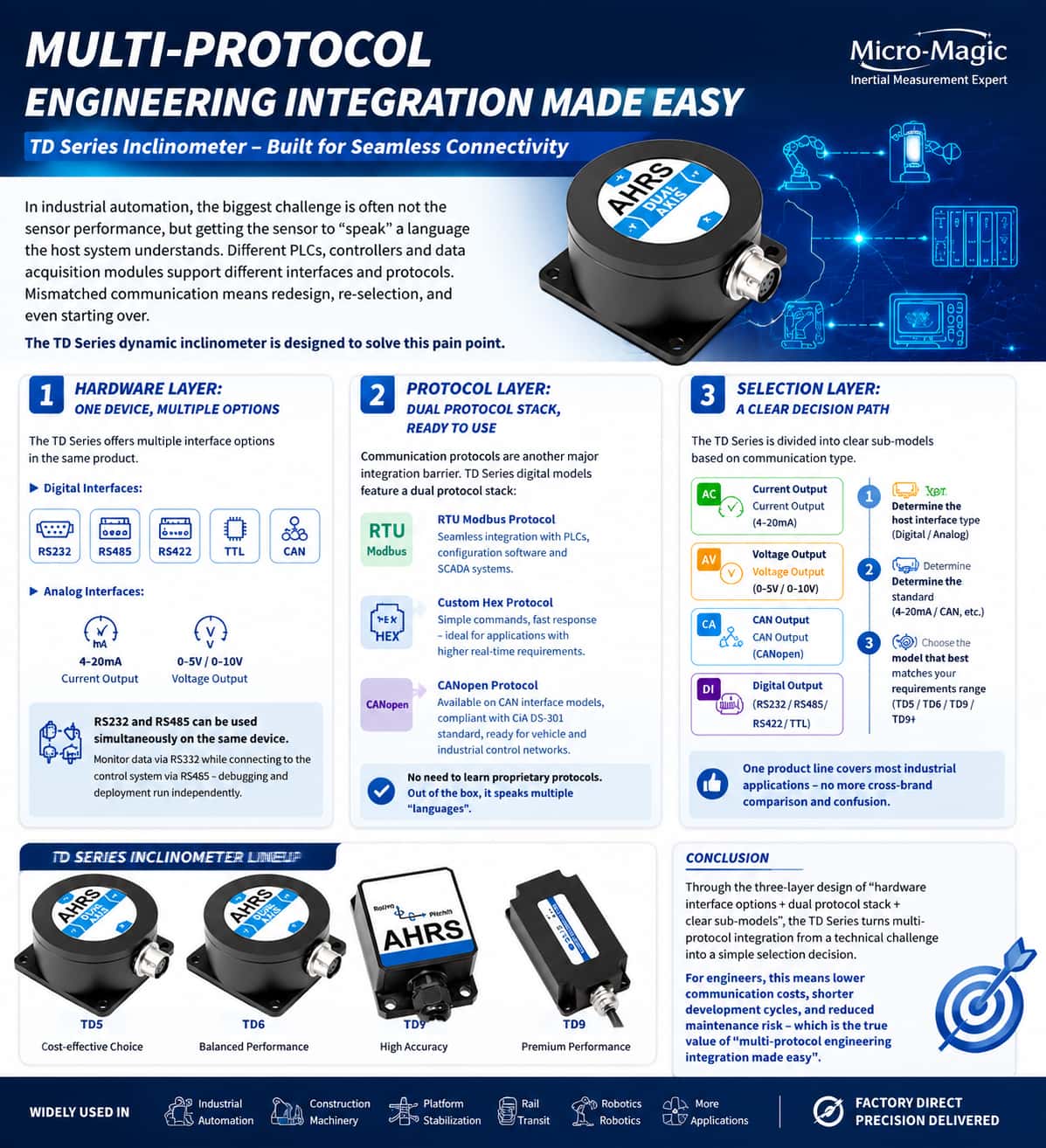
The TD series encompasses a wide range of models covering all mainstream communication methods used in the industrial sector, broadly categorized into digital and analog interfaces. Digital interfaces include RS232, RS485, RS422, TTL, and CAN bus; analog interfaces are available in both current and voltage types, supporting outputs such as 4–20mA and 0–20mA (current) and 0–5V, 0.5–4.5V, and 0–10V (voltage). Regarding communication protocols, the products are compatible with Modbus RTU, the custom 0x68 protocol, and CANopen, truly achieving "multi-purpose functionality and on-demand adaptation."
2. Digital Interfaces: Flexible Data Exchange Channels
TD series models with digital interfaces support various output methods, including RS232, RS485, RS422, TTL, and CAN. This "multi-interface" design philosophy allows engineers to select the communication method best suited to their specific requirements:
RS232 is ideal for short-range, point-to-point communication, offering ease of debugging and strong compatibility.
RS485 supports long-distance transmission of up to 2,000 meters and allows for multiple sensor nodes, making it the preferred choice for industrial fieldbuses.
RS422 supports full-duplex communication, making it suitable for scenarios requiring simultaneous data transmission and reception.
TTL operates at 3.3V/5V logic levels, facilitating direct integration with embedded systems (such as STM32 and Arduino).
CAN bus is designed specifically for automotive and industrial control applications, offering robust interference resistance and high real-time performance.
3. Analog Interfaces: Classic, Reliable Industrial Signals
For traditional industrial environments that still rely heavily on PLC analog data acquisition modules, the TD series provides a comprehensive range of analog output solutions. Current-output models support 4–20mA, 0–20mA, and 0–24mA ranges. The 4–20mA range is the most common industrial standard, offering advantages such as strong noise immunity and suitability for long-distance transmission. Zero-point output corresponds to 12mA (for the 4–20mA mode) or 10mA (for the 0–20mA mode), with angle calculation based on a simple, reliable linear proportional relationship.
Voltage-output models support three output ranges—0–5V, 0.5–4.5V, and 0–10V—ensuring compatibility with the analog input modules of various PLCs. Zero-point output corresponds to 2.5V (for the 0–5V mode) or 5V (for the 0–10V mode), utilizing a similarly straightforward calculation method.
The primary advantage of analog interfaces is their "plug-and-play" capability; there is no need to write complex communication protocols. Angle values can be derived directly by acquiring voltage or current readings via an ADC, significantly lowering the barrier to system integration.
4. Communication Protocols: A Blend of Standardization and Customization
At the protocol level, the TD series balances standardization with flexibility.
The Modbus RTU protocol, a de facto standard in industrial automation, is widely supported via the RS485 interface. By using standard Modbus function codes (such as 0x03 for data reading), the device can easily interface with various PLCs, HMI/SCADA software, and control systems.
The custom protocol is a highly efficient hexadecimal communication protocol used by digital models. Data frames begin with the identifier 0x68 and include fields for data length, address code, command word, data payload, and checksum. This protocol supports a comprehensive range of functions—including reading single-axis or dual-axis angles, setting relative/absolute zero points, adjusting baud rates, toggling between request-response and automatic output modes, and modifying module addresses—all characterized by concise commands and rapid response times.
The CANopen protocol is specifically designed for products with CAN interfaces and utilizes the standard CANopen protocol stack. Parameter configuration is handled via SDOs (Service Data Objects), while real-time angle data transmission occurs via PDOs (Process Data Objects). It supports features such as node ID configuration (default 0x05), baud rate settings (configurable from 100kbps to 1Mbps), and multiple data output rates (5Hz to 50Hz), fully meeting the requirements of industrial control and automotive applications. 5. Selection Recommendations
When selecting a model for a specific project, consider the following factors:
Control System Interface: If the system already utilizes an RS485 bus, prioritize RS485+Modbus; if using PLC analog modules, opt for 4–20 mA current output or 0–10 V voltage output.
Transmission Distance: For long distances (>50 meters), RS485 or 4–20 mA current output is recommended; for short distances, RS232, TTL, or voltage output are suitable options.
Real-time Requirements: For high-real-time applications (such as robotics or vehicle control), a CAN interface is recommended; for general industrial monitoring, either digital or analog interfaces will suffice.
Multi-node Networking: When multiple sensors need to be connected in parallel, RS485+Modbus or CAN bus is the optimal choice.
Conclusion
By featuring a dual-interface design (supporting both digital and analog outputs) and compatibility with multiple protocols—including Modbus, custom protocols, and CANopen—the TD series dynamic inclinometers truly embody the design philosophy of "one platform, multiple interfaces, and on-demand adaptation." Whether you are building a new Industrial IoT system or upgrading a traditional PLC control cabinet, the TD series offers the ideal communication solution, making inclinometer data acquisition simpler than ever.
leave a message
Scan to Wechat :