
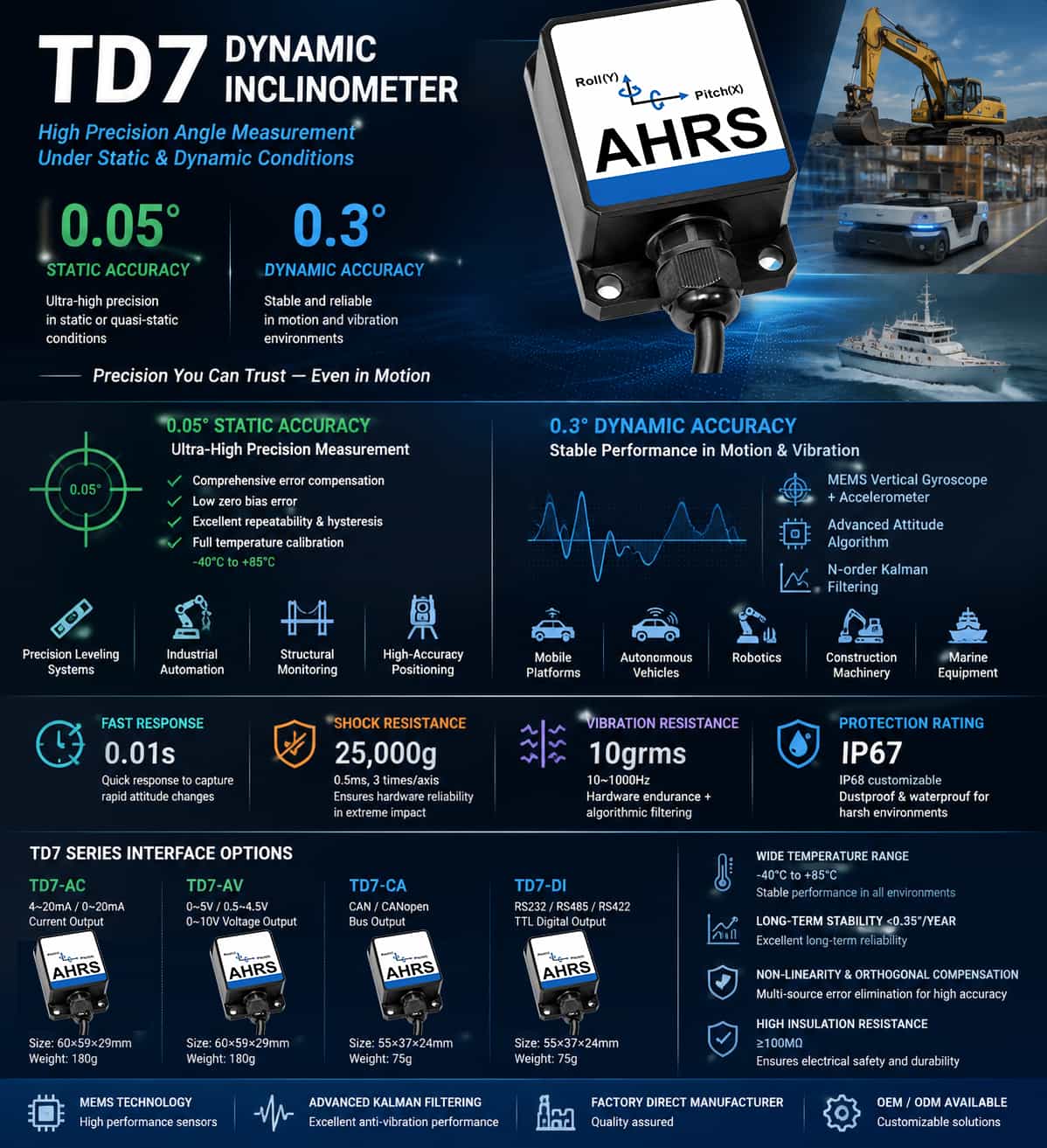
The TD7 series represents a new generation of high-performance dynamic inclinometers, available in four interface configurations: current output (TD7-AC), voltage output (TD7-AV), CAN output (TD7-CA), and digital output (TD7-DI). This series achieves high levels of accuracy in both dynamic and static measurement modes; the key accuracy parameters are detailed below.
1. Dynamic Accuracy vs. Static Accuracy
The core accuracy specifications for the TD7 series are a dynamic measurement accuracy of 0.3° and a static accuracy of 0.05°. These figures reflect the sensor's performance under two distinct operating conditions.
The dynamic accuracy of 0.3° represents the maximum error when measuring inclination in environments characterized by motion or vibration. The TD7 incorporates an internal vertical gyroscope and accelerometer, an integrated attitude solver, and optimal digital filtering for noise reduction. Combined with an N-order Kalman filter algorithm, it accurately outputs the object's attitude angles even amidst strong vibration and movement. This specification is critical for evaluating the sensor's suitability for applications involving mobile platforms, vehicles, robots, or vibrating machinery.
The static accuracy of 0.05° represents the combined error under stationary or quasi-static conditions across the full operating temperature range of -40°C to +85°C. This figure encompasses errors arising from absolute linearity, repeatability, hysteresis, zero-point offset, and horizontal axis misalignment. A static accuracy of 0.05° is considered high-performance in the field of industrial inclination measurement.
The nearly six-fold difference between these two values serves as a reminder that accuracy decreases during dynamic operation—an inherent characteristic of dynamic measurement systems.
2. Temperature Drift and Zero-Point Stability
The zero-point temperature drift is ±0.01°/°C (for TD7-AC/AV models) or ±0.05°/°C (for TD7-CA/DI models). Taking the TD7-AC as an example, the zero-point may drift by approximately 0.6° when the ambient temperature shifts from 25°C to 85°C. For equipment operating outdoors or across wide temperature ranges, this parameter directly impacts long-term measurement reliability.
The sensitivity temperature coefficient is ≤200 ppm/°C (TD7-AC/AV) or ≤150 ppm/°C (TD7-CA/DI). This parameter indicates the extent to which temperature fluctuations affect the sensor's "ratio of output change to angular change." A value of 200 ppm/°C means that for every 1°C change in temperature, the sensitivity undergoes a relative change of approximately 0.02% (two parts in ten thousand).
The TD7 series employs various techniques—such as non-linearity compensation, orthogonality compensation, and temperature drift compensation—to eliminate sources of error, ensuring stable measurement performance across a wide temperature range of -40°C to +85°C.
3. Long-term Stability
The long-term stability specification is <0.35°. This figure represents the maximum deviation between the sensor's output and its initial value after one year of continuous operation at room temperature. It implies that over the sensor's average service life of 55,000 hours (approximately 6.3 years), accuracy will drift slowly over time, with the maximum deviation remaining within 0.35°.
4. Interpretation of Key Response Time and Environmental Reliability Parameters
Response Time (0.01s)
This refers to the time required for the output to reach a stable, standard value following a step change in angle. A response speed of 0.01 seconds (10 ms) enables the sensor to track rapid changes in attitude in real-time. This makes it suitable for time-critical applications such as robotic motion control and dynamic marine navigation, serving as the temporal guarantee for achieving 0.3° dynamic accuracy.
Shock Resistance (25,000g, 0.5ms, 3 shocks per axis)
The sensor's internal MEMS structure sustains no permanent damage or zero-point offset after enduring an instantaneous shock of 25,000 times the acceleration due to gravity. This specification ensures that the device's long-term stability (<0.35°/year) remains unimpaired by accidental events like drops or collisions, acting as the first line of defense for hardware reliability.
Vibration Resistance (10grms, 10–1000Hz)
In environments subject to broadband random vibration (10–1000 Hz), the sensor not only withstands continuous stress at the hardware level but also effectively filters out vibration as noise using an N-order Kalman filtering algorithm. The synergy between hardware resilience and algorithmic filtering ensures the realization of 0.3° dynamic accuracy during motion. Ingress Protection Rating (IP67; IP68 customizable)
IP67 indicates complete protection against dust and the ability to withstand short-term immersion (1 meter depth for 30 minutes), while IP68 meets requirements for long-term, continuous immersion. Featuring a matte-anodized aluminum alloy housing and sealed cabling, the unit effectively prevents moisture and dust ingress—which could otherwise cause circuit corrosion or degrade insulation performance (≥100 MΩ)—ensuring stable, long-term operation in harsh environments such as outdoor, bridge, and marine applications.
5. Model Differences
All four models share essentially identical core accuracy specifications (dynamic: 0.3°; static: 0.05°), with the primary differences lying in their output interfaces:
TD7-AC: 4–20 mA / 0–20 mA current output;
TD7-AV: 0–5 V / 0.5–4.5 V / 0–10 V voltage output;
TD7-CA: CAN/CANopen bus output;
TD7-DI: Supports multiple digital interfaces, including RS232, RS485, RS422, and TTL.
Additionally, the TD7-CA and TD7-DI models are more compact (55 × 37 × 24 mm) and lighter (75 g), whereas the TD7-AC and TD7-AV models measure 60 × 59 × 29 mm and weigh 180 g.
leave a message
Scan to Wechat :