
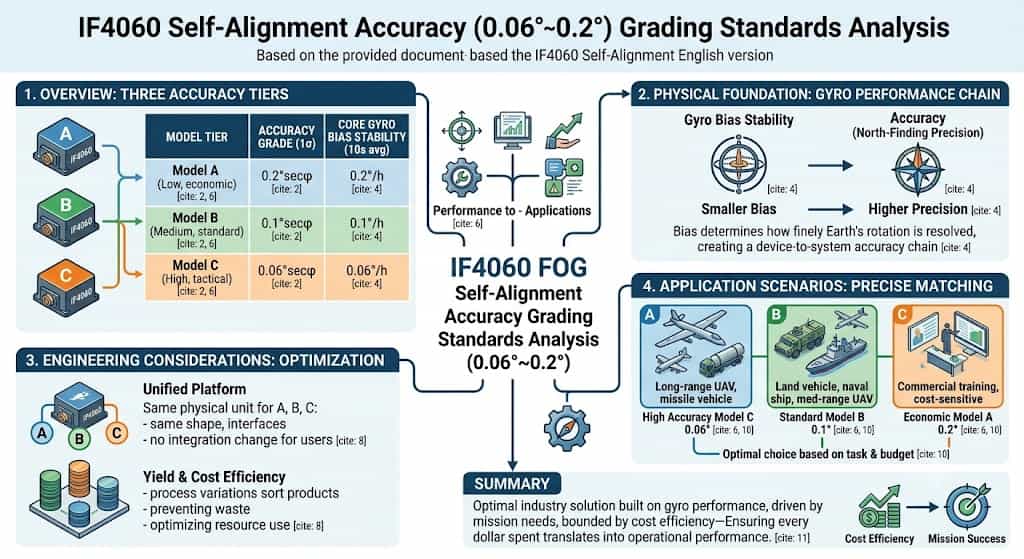
 The IF4060 fiber-optic inertial navigation system is available in three models—A, B, and C—corresponding to low, medium, and high precision levels, respectively. Their self-north-seeking heading alignment accuracies (1σ) are 0.2°secφ, 0.1°secφ, and 0.06°secφ. This classification system is not arbitrary; rather, it is based on a comprehensive assessment of core component performance, application requirements, and cost-effectiveness.
**Physical Basis for Precision Classification**
Self-north-seeking accuracy is fundamentally determined by the bias stability of the inertial components. The gyroscopes in the three IF4060 models feature bias stabilities (10-second average) of 0.2°/h, 0.1°/h, and 0.06°/h, respectively. Gyroscope bias stability is the critical factor governing north-seeking accuracy: the lower the bias, the more precisely the gyroscope can resolve the Earth's angular velocity component, resulting in higher north-seeking accuracy. The three precision tiers correspond directly to the three levels of gyroscope performance, establishing a complete precision chain extending from the component level to the system level.
**Industry Positioning of Precision Levels**
From an industry perspective, a north-seeking accuracy of 0.06°secφ falls into the high-precision tactical category, capable of meeting demanding requirements such as precision guidance and autonomous UAV navigation. The 0.1°secφ level represents medium-precision tactical grade, suitable for applications like land vehicle and naval vessel navigation. The 0.2°secφ level targets applications that are cost-sensitive and have relatively relaxed precision requirements. Together, these three levels cover the entire spectrum of needs, ranging from "high-end/cutting-edge" to "economical/practical."
**Engineering Considerations for Tiered Design**
The strategy of offering three precision levels on a single platform reflects mature engineering principles. All three models share identical external characteristics—such as form factor and interfaces—allowing users to switch flexibly between precision levels without altering their system integration schemes. Regarding component selection, fiber-optic gyroscopes naturally exhibit performance variations during production; classifying and shipping products based on actual measured performance is the most economical and rational approach. This method prevents the waste of high-performance components while ensuring that every unit is utilized to its full potential. Precise Matching to Application Scenarios
The 0.06° class is suited for missions requiring exceptional heading accuracy, such as long-range UAV reconnaissance and missile launcher alignment. The 0.1° class meets the needs of most tactical vehicles, naval navigation systems, and short-to-medium-range UAVs. The 0.2° class is appropriate for civil or training applications where cost control is strict and accuracy requirements are moderate. Users can select the optimal option from these three accuracy tiers based on mission requirements and budget constraints.
The IF4060’s three-tier accuracy classification represents an optimal solution—grounded in gyroscope performance, driven by application needs, and balanced by cost-effectiveness—ensuring that every penny is spent where it counts most.
leave a message
Scan to Wechat :