
The IF4060 fiber-optic inertial navigation system (INS) not only possesses high-precision autonomous north-finding capabilities but also demonstrates exceptional tactical value through two advanced functions: dynamic base alignment and transfer alignment. These capabilities directly determine the system's rapid response and operational effectiveness when deployed on mobile platforms such as carrier-based aircraft, vehicle-mounted weapon systems, and UAV swarms.
1. Dynamic Base Alignment: Establishing an Initial Reference in a Swaying Environment
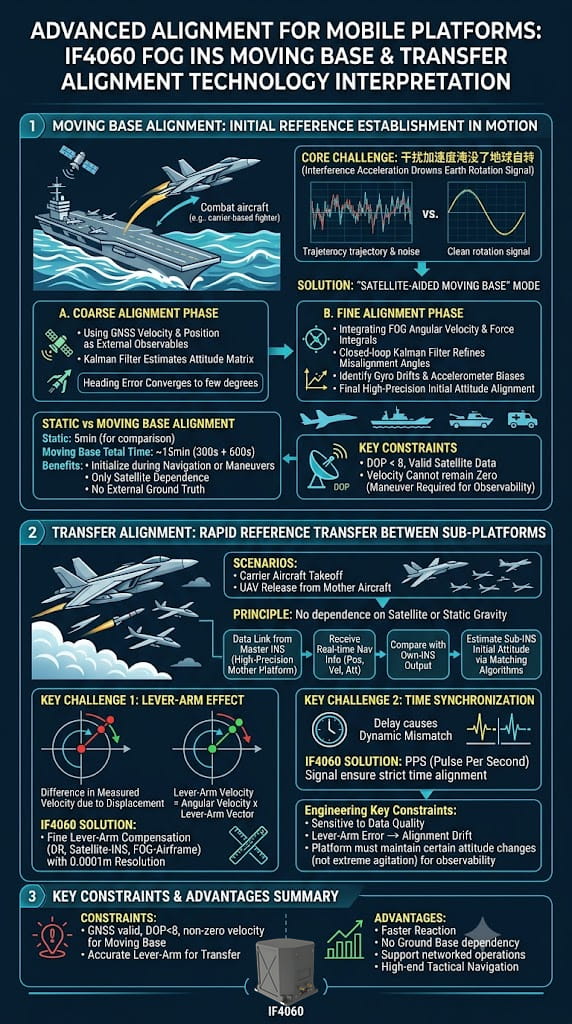
The primary challenge of dynamic base alignment is that the disturbance accelerations caused by the carrier's motion overwhelm the reference signals—such as the Earth's angular velocity and the gravity vector—typically used for traditional analytical alignment. The IF4060 addresses this issue using a "satellite-aided dynamic alignment" mode, which operates in two stages:
Coarse Alignment Stage: Velocity and position data from a satellite navigation system serve as external observations to construct a Kalman filter; this roughly estimates the attitude matrix and converges the heading error to within a few degrees.
Fine Alignment Stage: Building upon the coarse alignment, this stage incorporates the INS's integrated angular velocity and specific force data. A closed-loop Kalman filter is used to refine the estimation of misalignment angles while simultaneously identifying gyro drift and accelerometer bias, ultimately achieving high-precision initial attitude initialization.
Compared to static base alignment (5 minutes), dynamic base alignment takes approximately 15 minutes (300s + 600s). Although it requires more time, it allows for initialization while the platform is underway or maneuvering; furthermore, the alignment relies entirely on satellite navigation data without requiring an external ground-truth reference. The manual specifies that dynamic base alignment requires valid satellite data and a DOP value of less than 8. Additionally, the carrier's velocity cannot remain constant at zero—meaning a certain level of maneuver-induced excitation is necessary to ensure system observability.
2. Transfer Alignment: Rapid Reference Transfer Between "Parent" and "Child" Platforms
Transfer alignment is another advanced feature of the IF4060, designed for "parent-child" platform scenarios—such as aligning carrier-based aircraft before takeoff or aligning a UAV before its release from a mother ship. Its operating principle relies neither on satellites nor static gravity; instead, it receives real-time navigation data (position, velocity, and attitude) from a master inertial navigation system (a high-precision host platform) via a data link. By comparing this data with the output of its own internal inertial navigation system and employing matching algorithms, it back-calculates its own initial attitude and navigation parameters.
The core technical challenges of transfer alignment lie in the lever-arm effect and time synchronization. Because the slave and master inertial systems are installed at different locations, differences in linear velocity arise when the carrier maneuvers (lever-arm velocity = angular velocity × lever-arm vector). The IF4060 features a precise lever-arm compensation mechanism (handling DR-to-Inertial, GNSS-to-Inertial, and Inertial-to-Platform lever arms with a resolution of 0.0001 m). This mechanism translates the slave system's measurements to the master system's reference point, thereby eliminating matching errors caused by structural flexure and external lever-arm offsets. Simultaneously, the PPS (Pulse Per Second) signal ensures strict alignment of the time references between the master and slave systems, preventing dynamic mismatches caused by time latency.
3. Key Constraints for Engineering Implementation
Both dynamic-base alignment and transfer alignment are highly sensitive to input data quality. During dynamic-base alignment, the system fails to converge effectively if the GNSS velocity reading remains constantly zero or the DOP (Dilution of Precision) value exceeds limits. In transfer alignment, if lever-arm parameters are incorrectly configured, a fault indicator will signal "excessive alignment drift." Furthermore, both alignment modes require the carrier to undergo a certain magnitude of attitude change during maneuvering—avoiding violent oscillation—to ensure the full-state observability of the Kalman filter.
Summary
The IF4060’s dynamic-base and transfer alignment capabilities essentially extend "static north-finding" to "filter-based estimation in dynamic environments" and expand "autonomous alignment" into "distributed cooperative transfer." These features elevate the IF4060 from a simple position/attitude sensor to a high-end tactical navigation node capable of rapid response within networked combat systems.
leave a message
Scan to Wechat :