
1. Introduction
Driven by the wave of intelligent manufacturing and automation, industrial robots, Automated Guided Vehicles (AGVs), and robotic arms are becoming core execution units in modern industrial production systems. However, whether it involves high-speed AGVs navigating complex factory floors or multi-axis robotic arms performing micron-level operations during precision assembly, accurate attitude sensing and motion control are indispensable capabilities. Inertial Measurement Units (IMUs) and inclinometers serve as the core components that provide these devices with functions akin to a "sense of balance" and a "cerebellum."
2. Industrial Robots: Attitude Sensing and Multimodal Fusion
Industrial robots operating in scenarios such as welding, assembly, and material handling demand extremely high precision and repeatability regarding motion trajectories. While traditional encoders provide joint angle information, relying solely on them often fails to meet high-precision control requirements—especially under conditions of high-speed movement, vibration, shock, or long-term operation. The introduction of inertial navigation sensors and inclinometers provides a new dimension of attitude sensing for industrial robots.
2.1. Application of Inclinometers in Joint Control
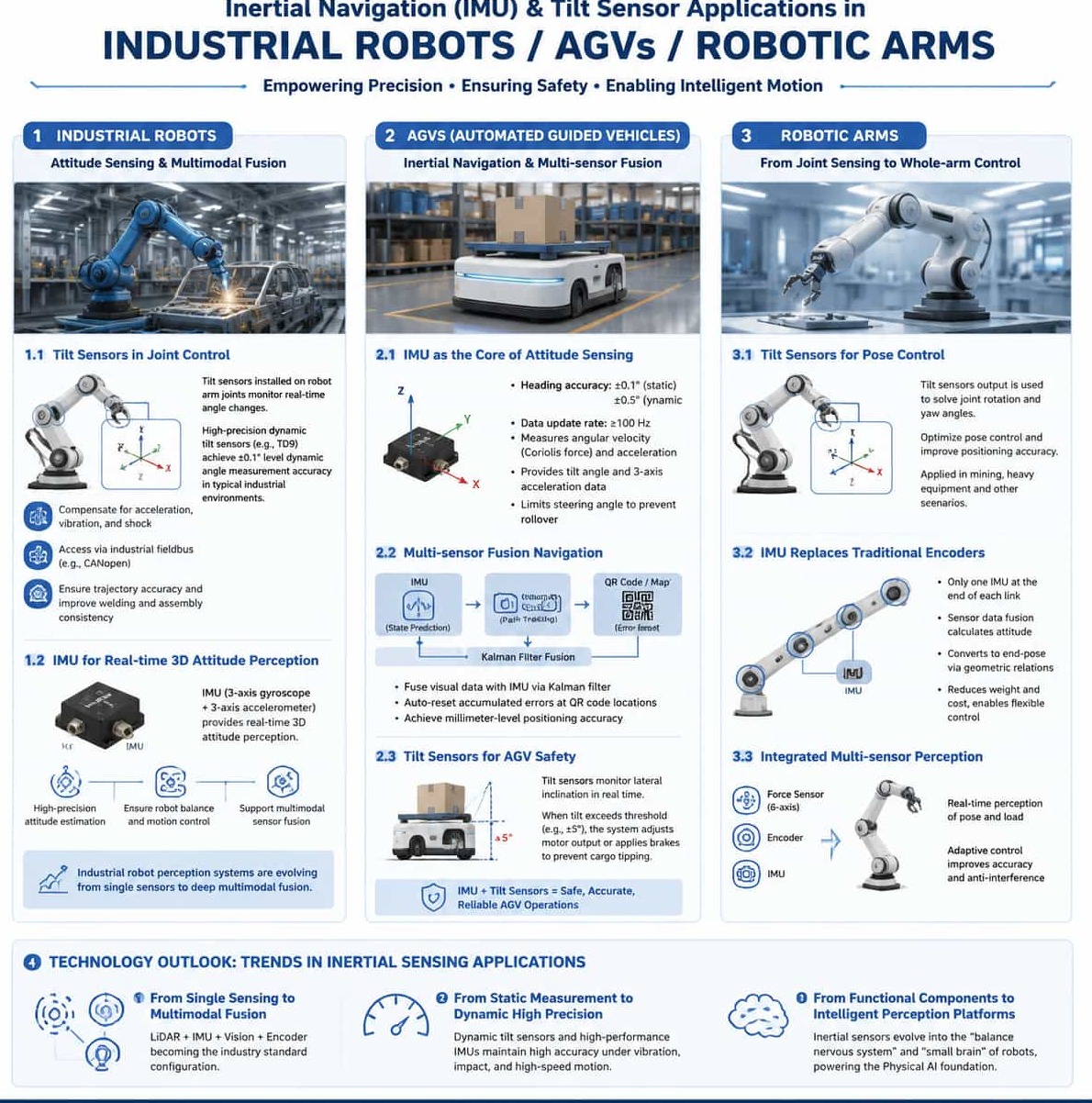
In industrial robots, dynamic inclinometers installed at robotic arm joints monitor angular changes across various axes in real time. High-precision dynamic inclinometers—based on 3D MEMS accelerometers and gyroscopes—utilize intelligent algorithms to fuse signals from both sensors. This effectively compensates for the impact of acceleration, vibration, and shock on angular output. For instance, the TD9 model from Maixinminwei achieves dynamic angle measurement accuracy better than ±0.1° in typical industrial environments. Integrating such sensors into control systems via industrial fieldbuses (such as CANopen) enables real-time trajectory calibration, ensuring consistency in tasks like welding and assembly; in automotive manufacturing, this significantly improves the positional accuracy of vehicle body weld points.
From a technical perspective, to address issues such as low measurement accuracy and complex control algorithms associated with industrial robot angle sensors, researchers have designed an accuracy analysis method based on smoothing filters. By applying a Savitzky-Golay filter to the raw data acquired by the sensors, output errors are effectively reduced. 2.2. IMU Provides Real-Time 3D Spatial Attitude Sensing
The role of Inertial Measurement Units (IMUs) in industrial robots is becoming increasingly critical. An IMU typically comprises a three-axis gyroscope and a three-axis accelerometer; integrating gyroscope data yields changes in attitude, while combining this with accelerometer data allows for the calculation of accurate pitch and roll angles. High-performance MEMS IMUs provide robots with real-time 3D spatial attitude sensing, ensuring stability control and effective mobility.
Precision inertial navigation technology is currently making rapid inroads into the industrial robotics sector. Automotive-grade IMU chips, utilizing advanced MEMS designs and ceramic hermetic packaging, offer high precision, high reliability, and stability across a wide temperature range. A trend toward the deep integration of LiDAR sensing and precision inertial navigation has emerged, with the two technologies being combined to develop multi-modal sensor fusion solutions for fields such as embodied AI and industrial robotics. This trend signifies a shift in industrial robot perception systems from single-sensor setups to deep multi-modal fusion.
3. AGV: Inertial Navigation and Multi-Source Fusion Positioning
Automated Guided Vehicles (AGVs) are key components of logistics systems in smart factories; their navigation accuracy directly impacts material handling efficiency and production safety. Traditional navigation methods—such as magnetic strip guidance and QR code positioning—suffer from limitations like fixed paths, high deployment costs, and susceptibility to environmental interference. In contrast, the application of inertial navigation and tilt sensors has revolutionized AGV navigation.
3.1. The IMU as the Core of AGV Attitude Sensing
The IMU is the core component enabling attitude and motion sensing in AGVs; without it, the vehicle would lose its ability to sense attitude, leading to motion control failure and a significant drop in operational precision. AGV-based IMU modules utilize three-axis MEMS sensors, achieving heading angle accuracy of ±0.1° in static conditions and ±0.5° in dynamic conditions, with data refresh rates typically exceeding 100 Hz.
High-precision IMUs measure the Coriolis force via MEMS gyroscopes to accurately detect any angular velocity deviations from linear motion; simultaneously, their accelerometers provide data on the vehicle's tilt (inclination) relative to the horizontal plane and three-axis acceleration. Building on this, the system sets a maximum steering angle threshold to actively limit the steering range during turns, thereby effectively preventing rollovers.
3.2. Multi-sensor Fusion Navigation
Single sensors have inherent limitations in complex environments: visual SLAM systems suffer from reduced localization accuracy due to dynamic environmental factors, while inertial navigation systems (INS) are prone to drift errors that accumulate over time. Consequently, multi-sensor fusion has become the mainstream solution for AGV navigation.
In practical applications, INS signals are used for AGV state prediction, while path-tracking navigation and RGB-D visual navigation combine to form a multi-camera vision system that corrects accumulated INS errors through system observation. A Kalman filter algorithm fuses visual and inertial data, allowing accumulated errors to be automatically reset at QR code locations. An AGV navigation algorithm combining dual-PID control with inertial navigation technology achieves millimeter-level positioning accuracy via a dual-closed-loop control architecture, while simultaneously reducing the required density of QR code placement.
In space-constrained environments with poor satellite signals—such as edible fungus factories—researchers have utilized Error-State Kalman Filters to fuse encoder and IMU data, achieving reliable navigation in narrow aisles and feature-sparse environments. In degraded environments like cable tunnels, visual-inertial SLAM algorithms based on point-line feature fusion effectively resolve localization challenges in settings with repetitive textures.
3.3. Inclinometers Ensuring AGV Operational Safety
Inclinometers play a pivotal role in AGV anti-rollover systems. An inclinometer integrated into the AGV chassis dynamically monitors the vehicle's tilt angle during turns or load fluctuations; if the tilt exceeds a preset threshold (e.g., ±5°), the system immediately adjusts motor output power or applies the brakes to prevent cargo from tipping over. Inclinometers with high protection ratings (such as IP69K) are capable of withstanding harsh warehouse conditions, including wet floors and dust.
4. Robotic Arms: From Joint Sensing to Whole-Arm Control
Robotic arms are core actuators in industrial automation, and their motion accuracy and flexibility directly determine production quality and efficiency. The application of inertial sensors and inclinometers in robotic arms is evolving from simple angle measurement toward full-state perception and intelligent control. 4.1. Precise Control of Robotic Arm Pose Using Tilt Sensors
Tilt sensors play a crucial role in controlling the pose of robotic arms. An existing patented invention discloses a pose control method based on tilt sensors; by constructing a mathematical model and calculating the robotic arm's rotation and yaw angles from the sensor outputs, the method optimizes pose control and enhances positioning accuracy. This technology has already been applied in demonstration projects for intelligent coal mining operations.
In heavy equipment such as coal mining roadheaders, mounting explosion-proof dynamic tilt sensors on the cutting boom allows for the measurement of the cutting head's pitch angle. When combined with angle sensors to measure the yaw angle, the system can obtain precise real-time data on the cutting head's orientation relative to the machine body. This system features a simple structure, ease of installation, and strong environmental adaptability.
4.2. IMUs Replacing Traditional Encoders
Cable-driven linkage robotic arms feature slender bodies and flexible movement, enabling them to perform tasks such as inspection and maintenance in confined spaces and complex, unstructured environments. However, the large number of kinematic joints makes installing encoders at every joint costly; furthermore, if the robotic arm's outer diameter is too small, suitable encoders may not even be available.
To address this challenge, a state-sensing and control method based on external IMUs was developed for cable-driven linkage robotic arms. An IMU is placed at the end of each linkage segment; sensor data fusion is used to calculate the IMU's orientation in real-time, which is then converted into the orientation of the segment's end based on geometric relationships. This approach effectively reduces the robotic arm's weight and enhances control flexibility.
In the field of flexible robotic arms, multi-IMU sensor fusion frameworks are employed to estimate position and orientation. Flexible links are modeled as a series of rigid segments, with joint angles estimated using accelerometer and gyroscope data. Implementing closed-loop control via real-time IMU orientation feedback significantly improves the operational robustness and flexibility of the robotic arm.
4.3. Comprehensive Sensing via Multi-Sensor Integration
Modern high-precision robotic arm motion control systems are evolving toward multi-sensor integration. By integrating six-axis force sensors, encoders, and IMUs, the system can sense the robotic arm's pose and load in real-time; when combined with adaptive sliding mode control algorithms, this integration significantly enhances motion accuracy and disturbance rejection capabilities. At the end-effector level, methods utilizing IMUs to acquire pose data in real-time can effectively compensate for pose deviations caused by joint torsion and connection errors.
5. Technological Outlook: Deep Multi-Sensor Fusion
The application of inertial navigation and inclinometer sensors in industrial robots, AGVs, and robotic arms is characterized by three major trends:
First, the evolution from single-mode sensing to multi-modal fusion. Since a single sensor cannot address all the challenges of complex industrial environments, multi-sensor fusion—combining LiDAR, IMUs, vision systems, and encoders—is becoming the industry standard.
Second, the shift from static measurement to high-precision dynamic sensing. Traditional static inclinometers can no longer meet the demands of high-speed motion scenarios; conversely, dynamic inclinometers and high-performance IMUs fuse accelerometer and gyroscope data to maintain high-precision output even under conditions of vibration, shock, and rapid movement.
Third, the upgrade from functional components to intelligent sensing platforms. Driven by the development of embodied AI and humanoid robots, inertial pose sensors are evolving from simple measurement elements into the "balance nerves" and "cerebellum" of robots. Relevant enterprises have established comprehensive technology and product ecosystems—spanning sensor chips, modules, and system assemblies—that serve as the "physical AI foundation" for robots and intelligent devices.
leave a message
Scan to Wechat :