
Technical Background: Transitioning from Static Measurement to Dual Static-Dynamic Modes
Traditional inclinometers rely on MEMS accelerometers to measure the component of gravitational acceleration along a sensitive axis to calculate the angle, achieving high precision in static or quasi-static environments. However, when the host platform is subject to motion, vibration, or shock, external accelerations superimpose onto the gravitational acceleration, causing significant measurement distortion. This inherent limitation restricts the use of traditional inclinometers in dynamic scenarios such as mobile platforms, construction machinery, and robotics.
The TD series of dynamic inclinometers fundamentally resolves this challenge through a fusion architecture combining a 3-axis MEMS accelerometer and a 3-axis gyroscope, alongside a dual-mode fusion algorithm that integrates static and dynamic capabilities. The core technology lies in the system's ability to assess the operating environment in real-time: in static mode, it employs a static algorithm to ensure ultimate precision; in dynamic mode, it automatically switches to a dynamic algorithm based on an N-order Kalman filter. By fusing the low-frequency stability of the accelerometer with the high-frequency response of the gyroscope, the system effectively suppresses measurement errors caused by vibration and shock. This technical approach enables the TD series to consistently output stable and reliable inclination data in complex dynamic environments.
Product Matrix: Four Series with Differentiated Positioning
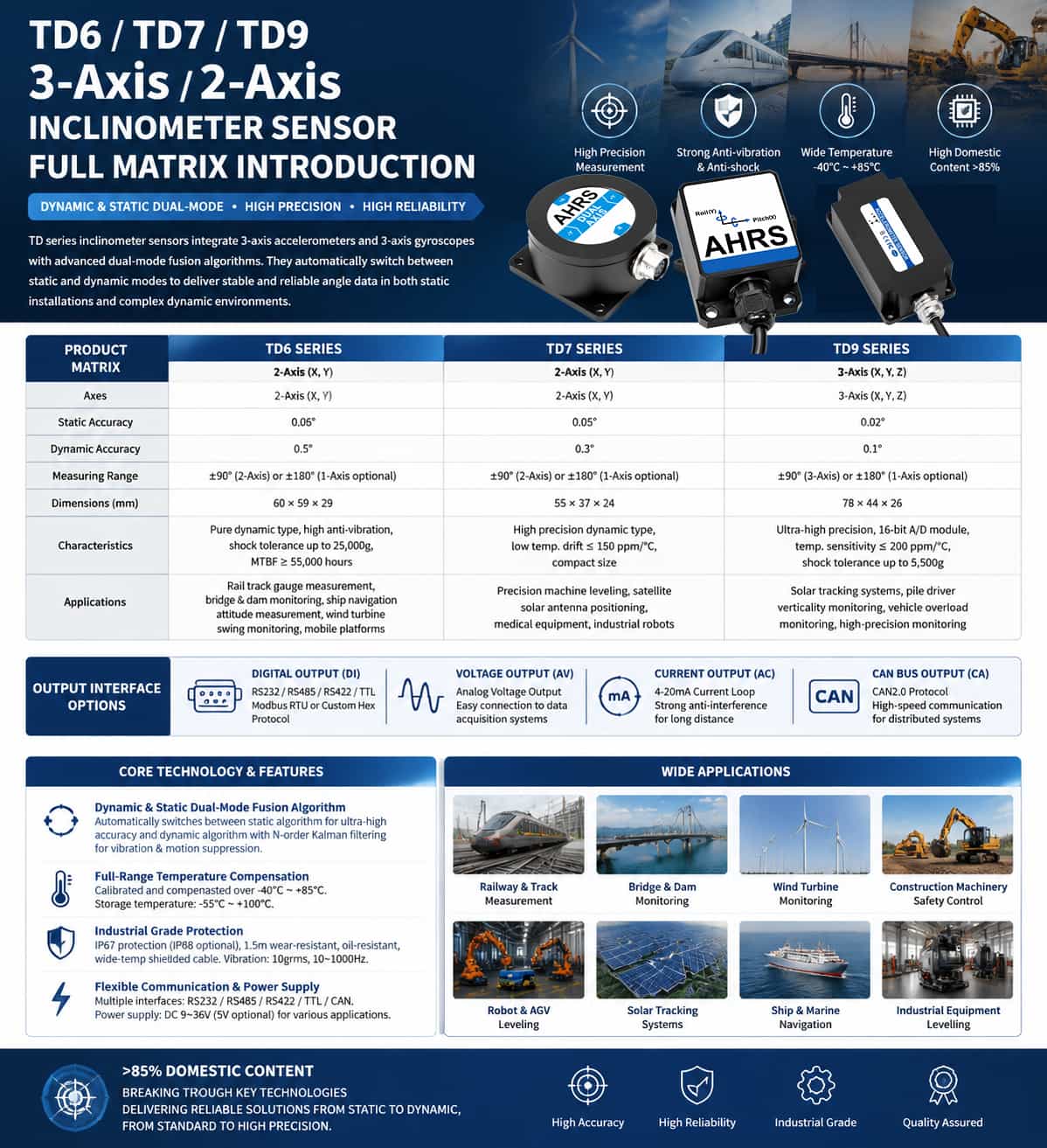
The TD series addresses a wide range of needs, spanning from standard industrial-grade requirements to high-precision applications; the products are categorized into four tiers based on precision levels and application scenarios:
|
Product Model |
Number of axes |
Static accuracy |
Dynamic accuracy |
Dimensions (mm) |
Positioning |
|
TD5 |
Three-axis |
0.1° |
0.5° |
66×56×29 |
Standard industrial grade, dual dynamic/static modes |
|
TD6 |
Dual-axis |
0.06° |
0.5° |
60×59×29 |
Dynamic type, high vibration resistance |
|
TD7 |
Dual-axis |
0.05° |
0.3° |
55×37×24 |
High-precision dynamic, compact design |
|
TD9 |
Three-axis |
0.02° |
0.1° |
78×44×26 |
Ultra-high precision, dual dynamic/static modes |
The TD5 series serves as a standard industrial-grade tri-axial inclinometer, offering a static accuracy of 0.1° and a dynamic accuracy of 0.5°. Featuring an integrated tri-axial accelerometer and gyroscope, it supports tilt monitoring across X, Y, and Z axes, with a measurement range of ±90° (tri-axial) or ±180° (optional single-axis). With a domestic content rate exceeding 85%, it is suitable for industrial applications such as forklift balance control, aerial work platforms, unloading machinery, and anti-tip protection for charging piles.
The TD6 series is positioned as a purely dynamic dual-axis inclinometer, specifically designed for mobile platforms and high-vibration environments. It delivers a static accuracy of 0.06° and a dynamic accuracy of 0.5°, utilizing an integrated vertical gyroscope and an N-order Kalman filter algorithm. Error sources are eliminated through multiple techniques, including non-linear compensation, orthogonality compensation, and temperature drift compensation. With a Mean Time Between Failures (MTBF) of ≥55,000 hours and a shock tolerance of 25,000g, it excels in high-dynamic scenarios such as railway gauge measurement, bridge and dam monitoring, marine navigation attitude measurement, and wind turbine oscillation monitoring.
The TD7 series represents high-precision dynamic inclinometers, boasting an improved static accuracy of 0.05° and a dynamic accuracy of 0.3°. Building upon the TD6, it features further optimized temperature drift control (≤150 ppm/℃) and a compact size of 55×37×24mm. It is ideal for applications demanding superior precision and compact dimensions, such as leveling control for precision machine tools, positioning for satellite solar arrays, and medical equipment.
The TD9 series is the flagship of the TD lineup, offering exceptional static accuracy of 0.02° and dynamic accuracy of 0.1°. It incorporates a high-precision 16-bit A/D module and a temperature sensor, featuring a sensitivity temperature coefficient of ≤200 ppm/℃ and a shock tolerance of 5,500g. It supports tri-axial (X, Y, Z) tilt monitoring and is widely used in applications requiring extreme measurement precision, such as photovoltaic tracking systems, verticality monitoring for piling rigs, and vehicle overload monitoring.
Output Interface Matrix: Comprehensive Coverage of Digital, Analog, and Bus Interfaces
Another core advantage of the TD series is its comprehensive range of output interfaces. Each precision series offers three output types—digital, analog, and bus—allowing users to make flexible selections based on the requirements of their backend control systems:
Digital Output (DI): Utilizes RS232, RS485, RS422, or TTL signal levels and supports standard Modbus RTU or custom hexadecimal protocols. Data is transmitted directly in digital format with high interference immunity, making it suitable for direct integration with digital systems such as PLCs and industrial PCs.
Voltage Output (AV): Outputs an analog voltage signal, facilitating easy connection to traditional voltage-based data acquisition cards or instruments for direct signal reading and processing.
Current Output (AC): Uses the industrial standard 4–20 mA current loop output. It offers strong interference immunity, making it particularly well-suited for long-distance transmission and harsh industrial environments.
CAN Bus Output (CA): Supports the CAN 2.0 protocol, making it ideal for distributed control systems—such as those in automotive and robotics applications—that require high-speed bus communication.
Core Technical Features
The entire TD series shares the following core technology platforms:
Dynamic-Static Dual-Mode Fusion Algorithm: The system automatically identifies its current operating state by analyzing acceleration and angular velocity data in real time. It employs a static algorithm during stationary periods to ensure maximum precision, and switches to a dynamic algorithm during movement, fusing gyroscope data to compensate for acceleration-induced interference. This mechanism enables a single sensor to handle two vastly different operating conditions: static installation and dynamic carrier applications.
Comprehensive Temperature Compensation and Aging: Before leaving the factory, all products undergo rigorous calibration, temperature compensation, and long-term stability (aging) testing. The operating temperature range spans -40°C to +85°C, with a storage temperature range of -55°C to +100°C.
Industrial-Grade Protection and Reliability: The entire series features an IP67 protection rating (IP68 available upon request) and comes standard with a 1.5-meter shielded cable that is wear-resistant, oil-resistant, and rated for a wide temperature range. Insulation resistance is ≥100 MΩ, and vibration resistance meets 10 grms (10–1000 Hz) standards.
Flexible Communication and Power Supply: Output interfaces include options for RS232, RS485, RS422, TTL, and CAN bus, supporting both Modbus RTU and custom hexadecimal protocols. The wide input voltage range (DC 9–36 V, with 5 V optional) accommodates various power supply conditions found in industrial environments. Selection Recommendations
The four products in the TD series form a comprehensive lineup covering a wide spectrum of specifications—ranging from standard industrial grade to ultra-high precision, 3-axis to 2-axis configurations, and general-purpose to compact designs. The TD5 serves as a cost-effective choice for standard industrial applications requiring 3-axis monitoring, while the TD6—with its optimization specifically for dynamic performance—is better suited for mobile platforms and high-vibration environments. The TD7 offers an optimal solution when both high precision and a compact footprint are required. Finally, for applications demanding the utmost precision—such as solar tracking and high-accuracy monitoring—the TD9 represents the pinnacle of domestic MEMS inclinometer technology, delivering a static accuracy of 0.02° and a dynamic accuracy of 0.1°. With a domestic content rate exceeding 85%, the series not only overcomes key technological barriers but also provides industries with complete tilt measurement solutions that span the full range from static to dynamic monitoring and from standard to high-precision performance.
leave a message
Scan to Wechat :