

Recently, Micro-Magic Inc officially launched a high-performance tactical grade MEMS inertial measurement unit (IMU) product - U5000, which is a benchmark for the well-known Sensonor STIM320 series products in the industry. This domestically produced IMU not only achieves benchmarking in core performance indicators, but also demonstrates good compatibility and upgrade potential in exterior structure, electrical interfaces, and other aspects, providing a new cost-effective choice for attitude perception and navigation applications in industrial, aerospace, unmanned systems and other fields In terms of core performance indicators, U5000 demonstrates tactical level accuracy comparable to STIM320. Its gyroscope zero bias stability (Allen variance) reaches ≤ 0.1°/h, angle random walk ≤ 0.1°/√ h, accelerometer zero bias instability ≤ 30μg, overall stable and reliable performance, especially maintaining good compensation effect in the full temperature range (-40℃ to +80℃). U5000 supports a wide temperature range of -40℃ to +85℃ and has full temperature compensation, which can maintain stable output in complex environments. This product has high bandwidth (≥200Hz), good vibration and impact resistance, and demonstrates solid environmental adaptability. In terms of external dimensions, weight, and structural design, the U5000 is comparable to the STIM/320. It employs a compact package design to align with the trend of miniaturization in modern equipment. The U5000 measures 44.8×38.6×21.5 mm and weighs approximately 52 grams. With a structurally reinforced design, it is well-suited for installation in high-dynamic or harsh environments. U5000 provides clear installation benchmarks and coordinate system definitions, supports standardized operations for mechanical fixation and electrical connections, and reduces the difficulty of system integration. The data interface and communication protocol are the key to integrating IMU into the system. The U5000 is equipped with multiple communication interfaces, including RS232, RS422, as well as dedicated synchronization signals TOV and PPS inputs, supporting external GNSS receivers for time synchronization and data fusion. Its default output adopts 55AA frame format, with clear structure, complete verification, and supports user configuration of baud rate and output frequency, with strong compatibility. From the perspective of application scenarios, U5000, with its higher precision sensing performance, is mainly targeted at fields that require extremely high measurement stability, such as satellite communication dynamic communication (SOTM), high-precision surveying and mapping systems, autonomous driving testing platforms, aviation navigation and stability control, etc. The launch of U5000 marks that the company's high-performance MEMS IMU has the ability to benchmark with international mainstream products. Not only does it closely follow the STIM series in key performance parameters, but it has also been enhanced in interface flexibility, protocol openness, and other aspects, providing users with a solution with compatibility potential and more configuration freedom. With the continuous deepening of market applications, this product is expected to play an important role in unmanned systems, high-end equipment, autonomous navigation and other fields, promoting technological progress and cost optimization in related industries.
Read More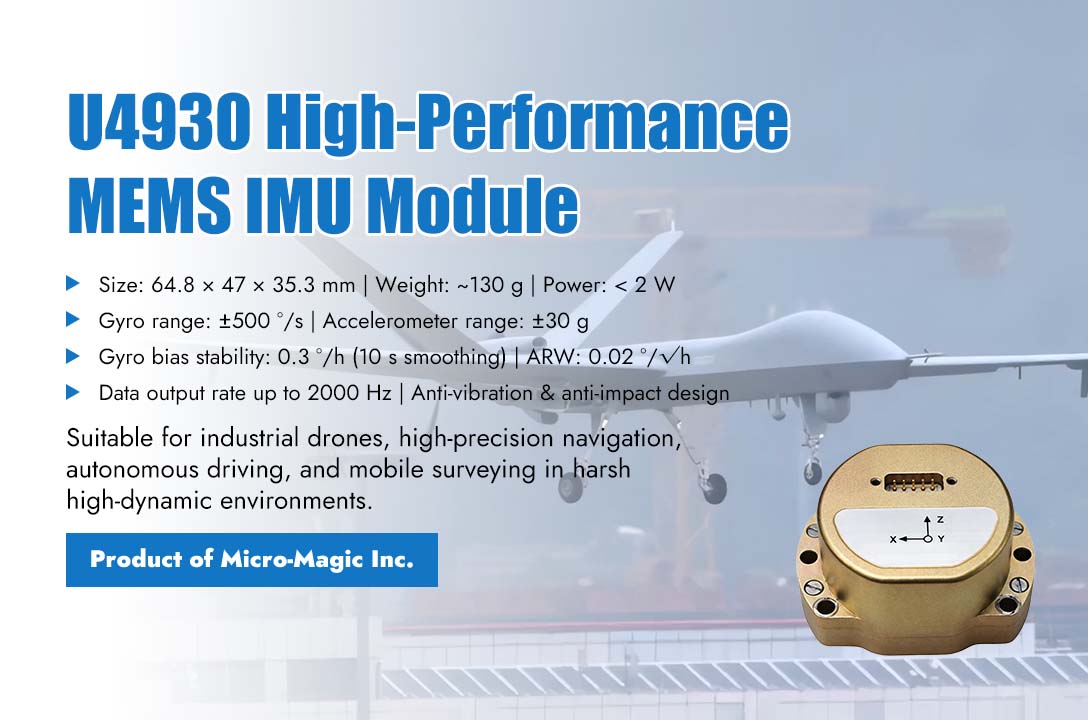
Recently, MEMS technology supplier Micro-Magic Inc. launched its U4930 series high-precision MEMS inertial measurement module (IMU). This product quickly attracted the attention of integrators in the fields of industrial drones, high-precision navigation, autonomous driving, and mobile surveying, thanks to its excellent core performance, robust and compact design, and a key market positioning to become a compatible and upgrade option for Honeywell's classic HG4930 IMU. The design philosophy of U4930 is very clear: to provide more competitive performance while maintaining a physical form and electrical interface similar to the widely used HG4930 in the industry. Its external dimensions are 64.8 × 47 × 35.3 millimeters, with a weight of approximately 130 grams and a steady-state power consumption of less than 2 watts. These features enable it to seamlessly adapt to the system space and power architecture originally designed for HG4930, greatly reducing the mechanical and electrical design costs for users when replacing or upgrading products. At the performance level, U4930 has demonstrated comprehensive improvements. It integrates high-performance three-axis MEMS gyroscopes and accelerometers, and achieves precise compensation in the entire temperature range through internal algorithms. The measurement range of its gyroscope can reach up to ±500°/s, which is better than the ±400°/s of HG4930; the range of its accelerometer reaches ±30g. More importantly, its precision specifications — featuring gyro bias stability of 0.3°/h (10-second smoothing) and angular random walk as low as 0.02°/√h — enable it to meet the demands of highly stringent attitude measurement applications. At the same time, the module supports a data output rate of up to 2000Hz and is equipped with anti-vibration and anti-impact design, ensuring reliability and real-time data in high dynamic and harsh environments. U4930 adopts RS422 differential communication interface and supports custom communication protocol configured through host computer software, including synchronization support for GPS/GNSS time data and Pulse Per Second (PPS) signals, which makes it consistent with HG4930 in system integration logic. Users' existing data processing and navigation algorithms can smoothly transition. Micro-Magic explicitly stated in the information that the product is designed to be "compatible with HG4930", providing a practical and feasible technical path for existing HG4930 users seeking supply chain diversification, cost optimization, or performance improvement. The U4930 series offers three different precision levels of models, A, B, and C, covering different needs from cutting-edge scientific research to industrial applications. Its emergence marks the ability to directly benchmark with international mainstream products in the key field of high-precision MEMS inertial measurement, and through precise compatibility design, it brings users more flexible and valuable solution choices. U4930
Read More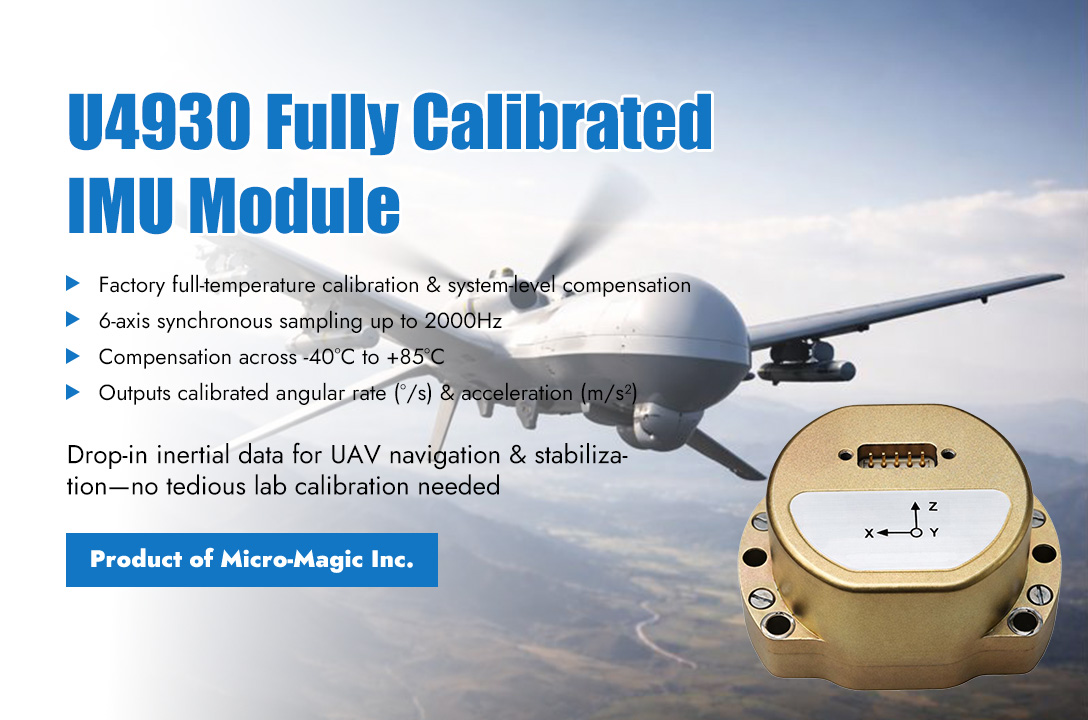
In the era of rapid advancement in drone technology, whether for high-definition aerial surveying and mapping, precision agricultural plant protection, or emergency supply delivery and complex environmental monitoring, drones have evolved from simple remote-controlled toys into highly intelligent aerial robots. Behind this transformation lies the flight control system's near-obsessive demand for real-time, precise attitude and motion data. The core technological cornerstone meeting this demand is the micro-electromechanical system (MEMS) inertial sensor—acting as the drone's "inner ear" and "balance nerves," silently sensing every moment of attitude change and motion state. These sensors serve as the physical foundation enabling drones to achieve stable hovering, autonomous navigation, agile maneuvering, and precise control. Traditional high-precision inertial navigation systems rely on bulky, expensive, and power-hungry optical or mechanical gyroscopes and accelerometers, severely limiting their application in consumer-grade and industrial-grade drones that prioritize lightweight, low cost, and long endurance. The groundbreaking advancements in MEMS technology have completely transformed this landscape. By seamlessly integrating micro-scale mechanical sensing structures with integrated circuit processes, it has miniaturized inertial sensors to the chip level. For instance, the ACM-1700 series of high-performance MEMS single-axis accelerometers from Micro-Magic employ advanced MEMS processes, achieving a wide range from ±10g to ±200g, a bandwidth up to 100Hz, and exceptional bias stability (down to 50μg) within a compact package measuring just 7.8 x 5.8 x 3mm. With robust construction capable of withstanding impacts up to 10,000g and full-temperature-range compensation via integrated temperature sensors, the ACM-1700 series ensures reliability and measurement consistency during drone's aggressive maneuvers and in complex environments. Whether monitoring linear acceleration or deceleration of drones or detecting vibrations caused by wind or maneuvers, the ACM-1700 series delivers precise data inputs. ACM-1700 Measuring Range ±10~30/±30~50/±70~100/±150~200g Measuring Axis X Zero Bias Stability (10s, 1σ) 50/100/200/500μg Zero Bias Temperature Coefficient (full temperature) 50/50/100/200μg/℃ Impact Resistance 10000g,2ms,1/2 sine Vibration Rectification Error (6grms) 0.4/0.15/0.05mg Communication Protocol I2C/SPI/UART Output Signal Digital Pack and Size Chip, 7.8*5.8*3mm Weight 1.5g However, perceiving only linear acceleration is insufficient to fully describe a drone's motion state. Rotational motion, specifically angular velocity around three axes, is equally crucial for attitude determination. The MG-XXXX series high-precision MEMS single-axis gyroscope by Micro-Magic is precisely designed for this purpose. This series employs an innovative MEMS structure capable of accurately measuring angular velocity along the rotation axis perpendicular to the chip surface. Its high performance is characterized by extremely low noise and exceptional bias stability, providing precise angular velocity feedback for drone flight control. Through its flexible SPI digital interface and configurable registers (such as adjusting output bandwidth from 12.5Hz to 800Hz or setting data update rates from 62.5Hz to 2000Hz), the flight control system can optimize sensor response for different flight modes (e.g., smooth cruising or agile maneuvers), achieving the best balance between suppressing high-frequency noise and maintaining rapid signal response. The combination of the MG-XX series and the ACM-1700 series forms the fundamental sensing pair for drones to perceive their three-dimensional spatial motion in principle. However, integrating multiple independent, high-performance MEMS sensor chips (three-axis gyroscope + three-axis accelerometer) into drone flight control and processing their raw data to obtain stable and usable attitude information is a complex engineering challenge involving precision calibration, temperature compensation, sensor fusion algorithms, and high-speed data processing. This is precisely where the value of MEMS inertial measurement modules such as U503, U4930, U16575. It is not a simple sensor stack, but a highly integrated and intelligent solution. This type of IMU module is housed in a sturdy aluminum alloy casing and has achieved precise positioning and installation of three-axis MEMS gyroscopes and three-axis MEMS accelerometers, integrating high-performance microprocessors. U503 U4930 U16575 Taking U4930 IMU module as an example, its core progressiveness lies in the full temperature calibration and system level compensation completed before delivery. The processor inside the module not only synchronously collects raw data from six axes at high speed (up to 2000Hz), but more importantly, it applies a pre calibrated compensation parameter matrix over a wide temperature range (-40℃ to +85℃) to perform real-time digital compensation for dozens of error terms such as zero bias error, scale factor nonlinearity, non orthogonal error, and acceleration sensitivity (g-sensitivity) of the gyroscope for each sensor. This allows the module to directly output high-precision angular velocity (°/s) and acceleration (m/s ²) data after temperature calibration and error correction. Users no longer need to perform tedious laboratory level calibration, greatly simplifying system integration and ensuring consistency and reliability of performance under different climate conditions. The RS422 interface it provides can stably output data packets containing angular velocity, acceleration, internal temperature, and high-precision timestamps at a frequency of up to 200Hz. It can also output TOV differential pulse signals that are strictly synchronized with data sampling, facilitating precise time alignment with external systems such as GPS, which is crucial for integrated navigation. In actual drone flight, these clean inertial data from IMU modules are fed in real-time into the core of flight control - attitude calculation and navigation algorithms (usually based on Kalman filters). The algorithm intelligently integrates the specific force information measured by the accelerometer (used to determine the direction of gravity, i.e. pitch and roll angles) with the angular velocity information measured by the gyroscope (used to integrate and obtain attitude changes). Through this' sensor fusion ', the system is able to overcome the respective shortcomings of accelerometers being susceptible to vibration interference during dynamic maneuvers and gyroscope integration drifting over time, thereby outputting stable, accurate, and error free real-time three-dimensional attitude (pitch, roll, yaw), angular velocity, and linear acceleration information. These pieces of information are the foundation of closed-loop control in flight control: the flight control compares the target waypoint or remote control instructions with the current real-time attitude and position, calculates the precise thrust commands of each motor, and drives the drone to complete a series of complex actions such as hovering, climbing, turning, obstacle avoidance, etc. Therefore, from the basic physical quantity perception provided by the chip level ACM-1700 accelerometer and MG-XXXX gyroscope, to the integrated, calibrated, and intelligent data supply achieved by the module level U503, U4930, U16575 inertial measurement units, MEMS inertial sensor technology constitutes a complete technology stack, gradually solving the problem of UAV attitude perception layer by layer. They enable modern drones not only to 'fly', but also to 'fly steadily', 'fly accurately', and 'fly intelligently'. With the improvement of autonomous driving levels and the increase in task complexity, the requirements for the performance of MEMS inertial sensors will also rise. The continuously evolving high-performance and highly integrated MEMS solutions are undoubtedly the indispensable underlying support for future unmanned aerial vehicles to move towards full autonomy, clustering, and intelligence.
Read More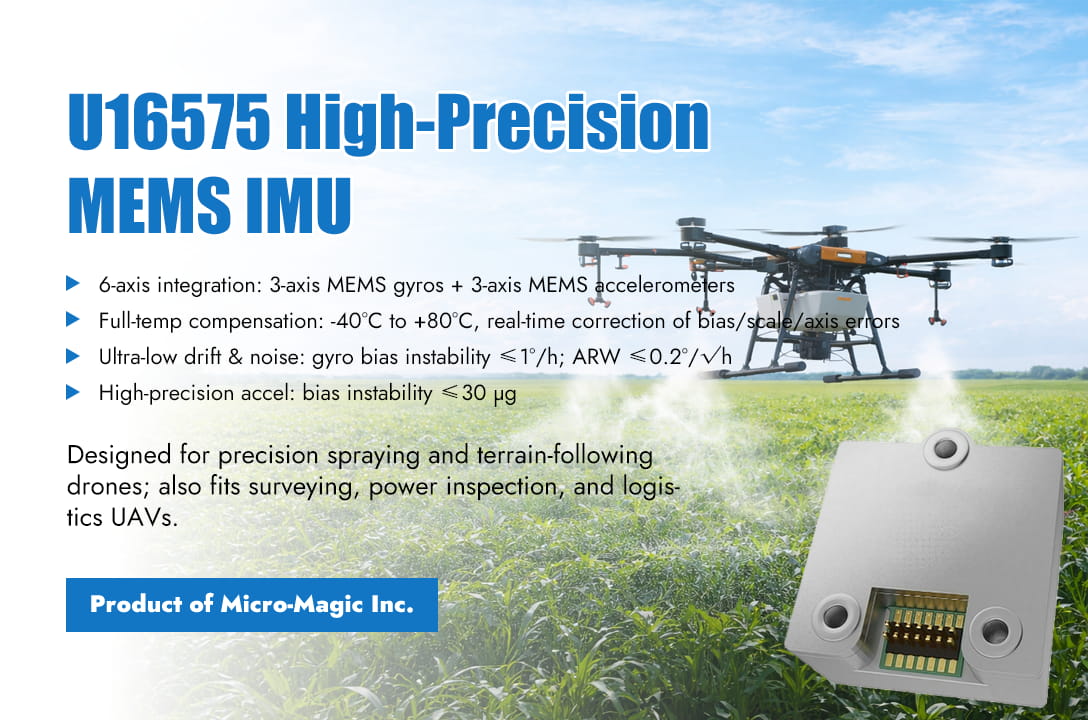
On the vast North China Plain, a large agricultural drone with a wingspan of over three meters glides steadily across wheat fields at an altitude of five meters. Unlike traditional spraying operations, this drone maintains exceptional stability while navigating undulating field ridges and fluctuating air currents, delivering uniformly atomized pesticide mist with clear, non-overlapping boundaries. The core behind this precise operation is its "Flight Central Unit"—the U16575 MEMS high-precision inertial measurement unit (IMU) recently introduced by Micro-Magic Inc. This sensor, hailed as the "industrial-grade intelligent perception core," is providing reliable technological support for the application of large drones in fields such as precision agriculture, thanks to its exceptional stability and accuracy. The terrain and climate challenges faced by large agricultural drones far exceed those of consumer grade models. The low altitude airflow disorder in the fields, the continuous high-frequency vibration caused by the engine and rotor, and the rigorous test of sensor stability for several hours of cross temperature operation are all major challenges that must be overcome to achieve technological upgrades such as uniform spraying and variable fertilization. The launch of high-precision IMU U16575 directly addresses these pain points. It integrates high-performance three-axis MEMS gyroscopes and three-axis MEMS accelerometers internally, and uses a system level compensation algorithm in the full temperature range (-40°C to +80°C) to real-time correct zero bias, scale factor, and even non orthogonal errors between axes, ensuring that attitude perception data is always accurate and consistent during all-weather operations of the drone from low morning temperatures to high afternoon temperatures. Stability is the cornerstone of agricultural efficiency, "said the technical expert from Micro-Magic. U16575 performs excellently in terms of parameters: gyroscope zero bias instability ≤1°/h, angle random walk ≤0.2°/√h; accelerometer zero bias instability ≤ 30μg. This means that even when the drone is turning or encountering gusts of wind, the IMU can provide extremely small noise and drift data, allowing the flight control system to quickly build high-precision attitude closed-loop control, thereby firmly locking in the preset flight altitude and route. For drones that need to use terrain following functions to operate on terraced fields or slopes, this' stability 'is crucial. In addition to accuracy, reliability is another lifeline for the large drone industry. U16575 adopts a lightweight aluminum alloy structure, which combines high strength with excellent vibration resistance and shock resistance, and can easily cope with the harsh mechanical environment of drone takeoff and landing and operation. Its compact size (22.4*22.3*13.7mm) and lightweight weight (about 12g) also contribute to the valuable payload space and endurance of the drone. "We have observed that an increasing number of drone system integrators require not only high performance but also complete solutions with 'high usability' and 'high reliability'," stated the sales director of Micro-Magic. "The hardware compatibility between the U16575 and the ADIS16575, coupled with the comprehensive technical support and communication protocols we provide, enables customers to swiftly complete product upgrades and verification, thereby shortening the time-to-market cycle." From precise spraying to surveying and exploration, from power inspection to logistics transportation, as the application scenarios of large-scale drones continue to deepen, the requirements for their "perception nerves" are becoming increasingly stringent. The U16575 high-precision IMU, with industrial grade performance, military grade reliability, and commercial grade cost, is becoming an indispensable key component in the high-end unmanned aerial vehicle field, helping unmanned systems achieve more accurate, reliable, and intelligent flight in a wider world.
Read More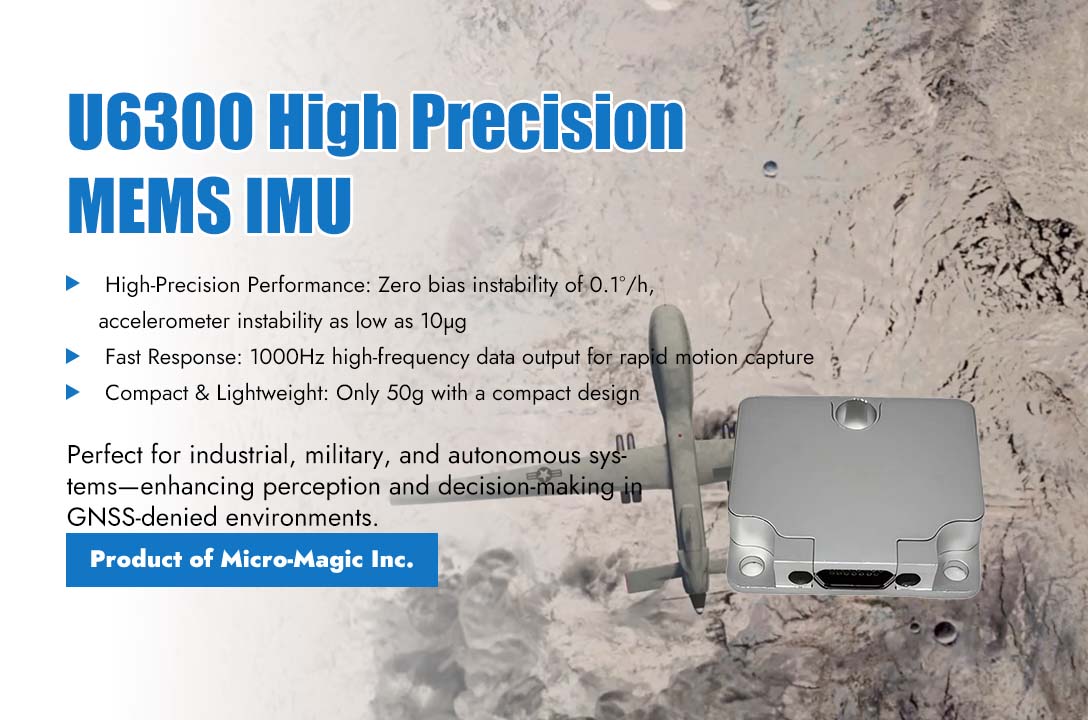
As unmanned systems and robot applications move from laboratories to industrial and military grade scenarios, they pose unprecedented demands on the accuracy, reliability, and environmental adaptability of core sensors, especially IMUs. Traditional low-cost MEMS IMUs are unable to perform long endurance and high-precision tasks due to insufficient accuracy and large drift; However, high-end solutions such as fiber optic gyroscopes (FOGs) are limited in large-scale applications due to cost, size, and weight constraints. As a leading designer and manufacturer of Inertial Sensors from China, Micro-Magic Inc has launched the U-Series high-performance and high-precision MEMS inertial measurement units, including the U5000, U6300, and U7000,which are precisely filling this market gap. This series of products aims to completely change the navigation, guidance, and control performance of unmanned aerial vehicles (UAVs), unmanned vehicles (UGVs), unmanned ships (USVs), autonomous underwater robots (UUVs), and various robot platforms, providing core support for achieving truly autonomous "perception and decision-making" in complex environments. Taking the U6300 from Micro-Magic Inc as an example, they integrate high-performance three-axis MEMS gyroscopes and three-axis MEMS accelerometers, and achieve breakthroughs in key performance indicators through precise system level design and algorithm optimization. The gyroscope's zero bias instability can reach 0.1°/h,while the accelerometer's zero bias instability is as low as 10 μg. This indicator enables the U6300 model to meet the needs of most industrial and even some tactical applications, especially during GNSS signal interruptions, significantly reducing position estimation errors and achieving longer autonomous navigation time. U6300 has undergone comprehensive temperature compensation within a wide temperature range of -40°C to +85°C, ensuring output stability in extreme weather conditions. Meanwhile, its excellent anti-vibration and anti-impact capabilities enable it to firmly adhere to platforms such as industrial robots, off-road UGVs, or high-speed drones, and work continuously and stably under harsh conditions. At the same time, the U6300 supports high-frequency data output of 1000Hz, which can accurately capture fast motion details. Its compact size (38.6 x 44.8 x 10 mm) and lightweight (50g) design greatly facilitate system integration. The product manager of Micro-Magic Inc stated that the development of the U-series is based on the urgent market demand for high cost-effectiveness and high reliability IMUs. We have successfully elevated the performance of MEMS inertial sensors to a new level through the optimization of core MEMS chips and advanced calibration compensation algorithms. The U series IMU product is not just a component, but also a crucial step in providing our customers with the cornerstone of 'autonomous perception' for unmanned systems and intelligent equipment.
Read More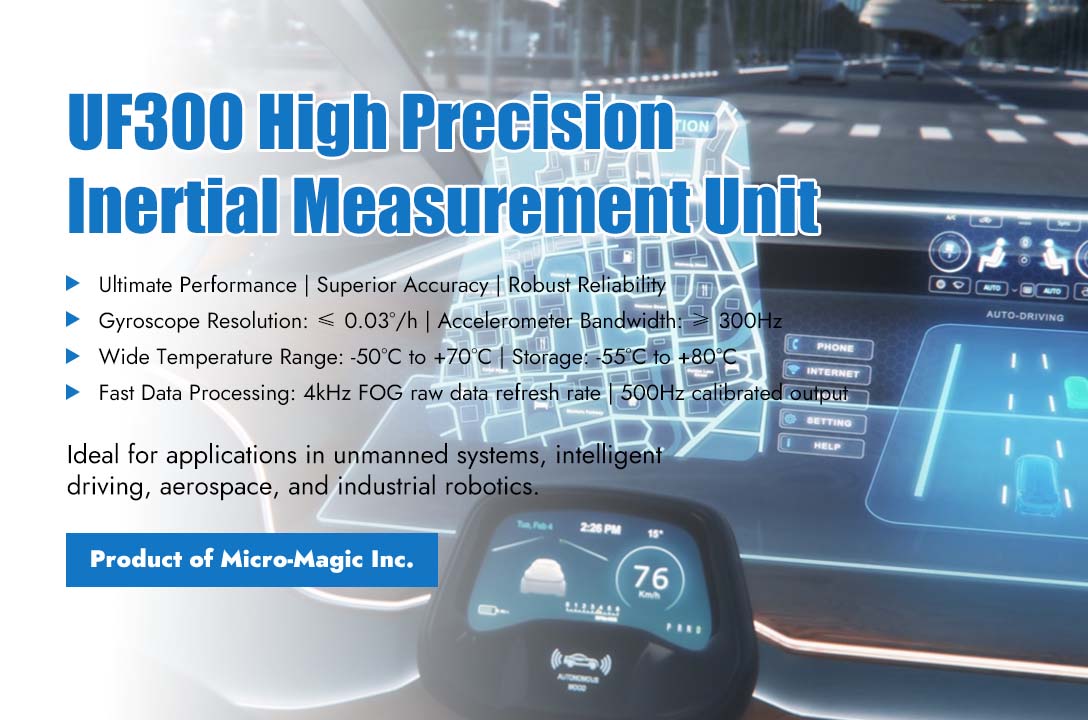
Micro-Magic Inc has launched a high-precision imu UF300, specifically designed for navigation systems. With cutting-edge fiber optic gyroscope technology as its core, it integrates high precision, miniaturization, and strong reliability, and is specially designed for intelligent equipment in harsh environments. Whether it's the agile handling of drones, the millisecond level response of intelligent driving, or the ultimate precision of missile flight control. The UF300 achieves a top-level accuracy in the industry with a 0.03°/h gyroscope zero bias stability and a 3×10^-5 g accelerometer zero bias stability, which is an order of magnitude higher than mainstream specifications. The UF300 series high-precision inertial measurement unit consists of three solid-state fiber optic gyroscopes, three quartz accelerometers, and a data packaging board. It adopts three-axis sharing technology and is designed for the needs of high-precision application backgrounds. The sensitive ring of the fiber optic gyroscope adopts magnetic shielding, and by reducing its diameter, it not only reduces the volume of the inertial component, but also improves the performance of the inertial component under vibration environment. The IMU platform with spatial diagonal damping layout ensures that the IMU components of the strapdown system have good isotropic dynamic response characteristics under vibration and impact conditions. FPGA circuit design can improve product performance in key indicators and overcome the limitations of analog signal processing, eliminating temperature sensitive drift and rotation errors. Main features of UF300 1. Ultimate Performance, Fearless of Limits ⚪ High precision perception: gyroscope resolution ≤ 0.03°/h, accelerometer bandwidth ≥300Hz, dynamically capturing subtle movements at every moment, with errors approaching zero. Adaptive filtering technology reduces zero drift and angle random walk by 50% -75%. ⚪ Super environmental adaptability: The working temperature ranges from -50 ℃ to +70 ℃, and the storage temperature covers from -55℃ to +80℃. It is stable from the polar regions to the desert. ⚪ High speed data empowerment: 4kHz FOG raw data refresh rate and 500Hz compensated calibrated gyroscope and accelerometer incremental information output, millisecond level response, providing delay free decision support for real-time control. 2. Lightweight Design, Flexible Adaptation ⚪ Small size and light weight: only 1800g±50, compact structure easily integrated into space limited equipment such as drones and robots. At the same time, the size can be reduced according to customer requirements, and reflector can be installed on the X and Y axes to meet customized needs. ⚪ Military grade reliability: No moving parts, all solid-state design, impact and vibration resistance, with a lifespan of up to 100000 hours, completely eliminating the hidden danger of mechanical wear and tear. 3. Versatile interface, seamless integration ⚪ Efficient power supply: Supports 28V wide voltage power supply with ripple ≤ 200mV, ensuring pure power supply under complex working conditions. ⚪ Multi-channel high-speed communication: RS-422 dual channel output, supporting custom transmission rates, compatible with mainstream control systems, data frame checksum design, ensuring zero information errors. Application Scenario - Precision is Everywhere ⚪ Unmanned system: Unmanned aerial vehicle precise hovering, autonomous obstacle avoidance, UF300 injects "super sensory nerves" into flight control. ⚪ Intelligent driving: The "invisible helmsman" of L4/L5 level autonomous driving, which perceives the body posture in real time and ensures driving safety. ⚪ Aerospace: from missile guidance to satellite attitude control, millimeter-level precision governs thousand-kilometer trajectories, where infinitesimal errors translate into mission-critical deviations. ⚪ Industrial robot: A "dynamic balancer" for high-speed robotic arms, achieving micrometer level motion trajectory control. Technical Details Showcase Hardcore Strength 1. Core parameters of fiber optic gyroscope: ⚪ Measurement range: ±300°/s, dynamic full coverage; ⚪ Random walk coefficient ≤ 0.003 °/√ h, leading the noise suppression industry; ⚪ Scale factor nonlinearity ≤ 10ppm, linear output without distortion. 2. Core parameters of accelerometer: ⚪ Range -10g to +10g, Precision measurement of instantaneous acceleration. ⚪ Bandwidth ≥ 300Hz, High-frequency vibrations cannot escape detection. Born for the Future, Fighting for the Ultimate UF300 is not only a product, but also synonymous with precise measurement. It helps customers break through technological boundaries and open a new era of intelligent equipment with military grade quality, aerospace grade precision, and industrial grade durability.
Read More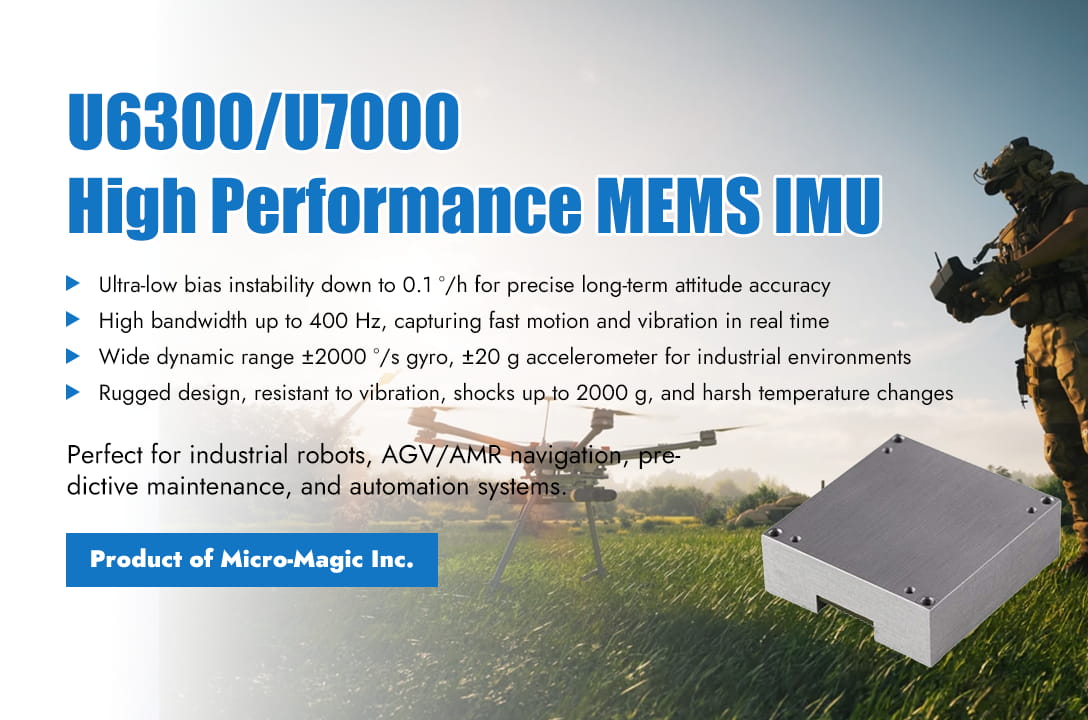
The application of MEMS inertial measurement units (IMU) in the industrial field mainly focuses on high-precision motion control, equipment monitoring, and automated production. Choosing a suitable MEMS IMU in the industrial application field requires comprehensive consideration of accuracy, environmental adaptability, interface compatibility, and cost-effectiveness. The application of MEMS IMU in the field of industrial robots and automation mainly focuses on attitude feedback and control, AGV/AMR navigation, and vibration monitoring and diagnosis. In the application of attitude feedback and control, MEMS IMU provides real-time attitude (pitch, roll, yaw) and angular velocity information for robot joints, end effectors or mobile platforms, achieving precise motion control, path planning and collision prevention. In the application of AGV/AMR navigation , MEMS IMU is integrated with wheel speed sensors, LiDAR, and visual sensors to provide dead reckoning functionality. When the external reference is temporarily lost, IMU can maintain short-term positioning and heading, improving the robustness and continuity of navigation. In the application of vibration monitoring and diagnosis, MEMS IMU is installed on robot joints, key structures, or motors to monitor the vibration spectrum and amplitude during operation, for predictive maintenance, and to identify early faults such as bearing wear, imbalance, and misalignment. The requirements for MEMS IMU in the field of industrial robots and automation mainly focus on the following aspects: 1. Requirements for static performance indicators (high precision) Zero bias stability is the most important indicator of static performance, and low zero bias stability means that the long-term accuracy of attitude estimation (pitch, roll, yaw) is crucial. When robots run for long periods of time or AGVs navigate accurately, low zero bias drift is the core to ensure attitude accuracy. The zero bias stability of gyroscopes usually requires <1°/h, and high-end applications require <0.5°/h. The zero bias stability index of accelerometers requires <1 mg. In addition, the angle random walk reflects the white noise characteristics of the gyroscope output, which determines the rate at which the angle integration error increases over time. Low ARW is the foundation for achieving high-precision posture, especially in a short period of time, and is particularly critical for motion control of high-speed and high dynamic robots. Taking the high-performance MEMS IMU U6300 series and U7000 from Micro-Magic Inc as an example: Index item U6300-A U6300-D U7000 Unit Gyro Bias instability 0.5 0.1 0.1 °/h Random walk 0.02 0.05 º/√hr Zero bias stability (10s) 1 3 °/h Accl Bias instability 10 15 μg Random walk 0.02 0.01 m/s/√hr Zero bias stability (10s) 100 100 μg 2. Dynamic performance requirements (high bandwidth, large range) The joint motion frequency of industrial robots is high, and the vibration frequency at the end of the robotic arm may be even higher. High bandwidth is crucial for accurately capturing fast motion and vibration. Usually, the bandwidth needs to be greater than 100 Hz, even hundreds of Hz. In addition, robots can quickly start and stop, collide, or AGVs can travel on uneven roads. Overload can cause data saturation distortion, therefore MEMS IMUs are required to have a sufficiently wide range. Typically, gyroscopes may require ± 300°/s to ± 2000°/s or higher, while accelerometers may require ± 2g to ± 50g or higher. Taking the products U3600, U5000, and U6488 from Micro-Magic Inc as an example: Index item U3600 U5000 U6488 Unit Gyro Range ±2000 ±400 ±450 °/s 3dB Bandwidth 116 250 400 Hz Accl Range ±12 ±10 ±20 g 3dB Bandwidth 145 100 268 Hz 3. Environmental adaptability requirements (excellent resistance to vibration and impact) The industrial environment is full of vibrations (motors, gears, conveyor belts, etc.). IMU must be able to suppress these vibration interferences and avoid outputting erroneous data (especially gyroscopes that are sensitive to linear vibrations and generate G-sensitive errors). Good mechanical design (such as damping) and advanced signal processing algorithms are required. Ensure that the equipment is not damaged and its performance is not permanently degraded when dealing with unexpected collisions, falls, or high impact operations. It usually needs to withstand impacts of thousands of g. Taking the products U3500,U3600 and U3700 from Micro-Magic Inc as an example: Index item U3500 U3600 U3700 Anti-Vibration(g,Rms) 1.0mm(10Hz-58Hz) &≤20g(58Hz-600Hz) Shock(g) 2000, <1ms Environment protection RoHS Directive 2011/65/EU EMC LVD Directive 2014/35/EU Drop test Free fall 3 times on a 75cm high experimental platform Temperature shock Raise the temperature from -40 to 85 ℃ within 1h, 5 times 4. System integration and practicality MEMS IMUs have been increasingly widely used in industrial and military fields due to their small size, light weight, and low power consumption. Miniaturization allows IMUs to be easily embedded into robot joints, linkage ends, compact AGV bodies, and even tool interiors without significant burden or design changes; Lightweight design minimizes the impact of IMU on the load capacity and motion performance of robots, especially for high-speed, high-precision, or collaborative robots; The low power consumption of IMU extends the battery life of mobile robots and wireless sensor nodes, reducing the overall energy consumption and heat dissipation requirements of the system. Taking the products U300, U3500 and U3000 from Micro-Magic Inc as an example: Index item U300-B U3500 U3000 Unit Dimension 22.4*22.4*7.4 22*22*10 59.6*59*23.5 mm Weight 7 8 120 g Power Consumption 0.3 0.3 0.6 W Voltage 3.3 3.3 5 V Conclusion Industrial grade MEMS IMUs need to achieve a high level of balance on these stringent indicators in order to meet the comprehensive requirements of modern industrial robots and automation systems for perception accuracy, reliability, real-time performance, and robustness. U3500 U5000 U6000
Read More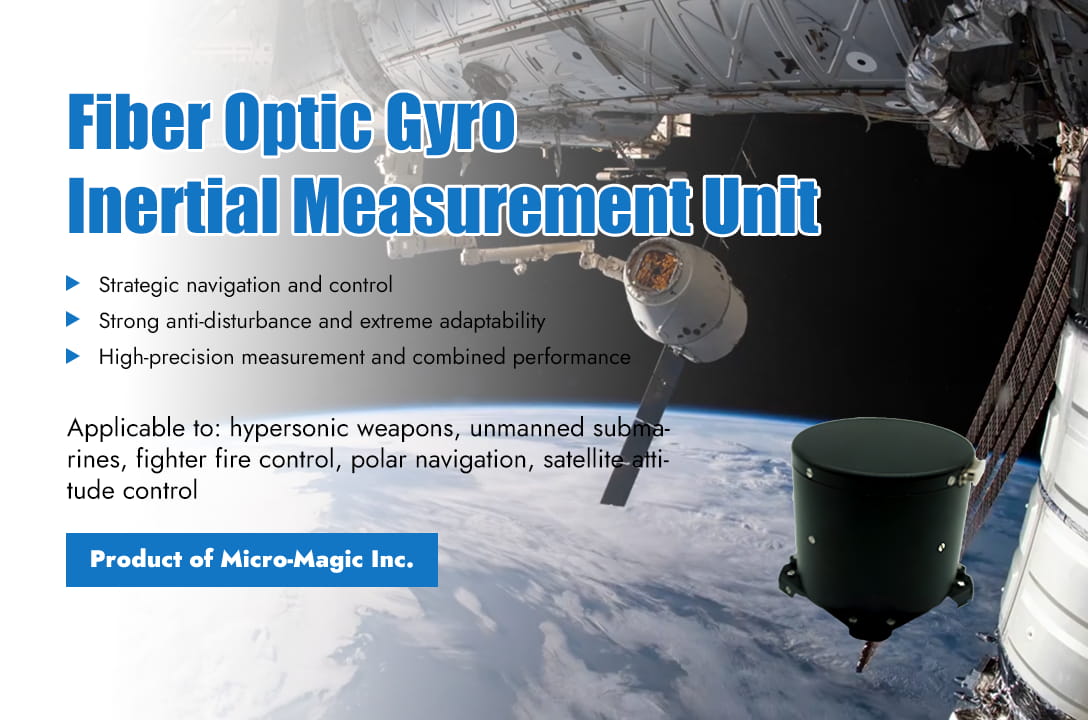
Quickly browse the article in one minute Fiber optic gyroscope IMU (FOG IMU) and MEMS IMU have significant differences in accuracy, environmental adaptability, reliability, and other aspects due to differences in technical principles. The position of fiber optic gyroscope IMU is still irreplaceable in the fields of strategic weapons, deep space/deep-sea exploration, high dynamic military systems, and scientific instruments. Its core advantages lie in the physical limit level accuracy, full temperature stability, and extreme environmental resistance. Even if some high-end MEMS approach tactical level performance, they still cannot meet the strategic level requirements of cutting-edge defense technology. Core applications in the field of cutting-edge defense technology 1. Strategic level military equipment navigation and guidance Intercontinental ballistic missiles and strategic nuclear submarines need to maintain ultra-high precision positioning (zero bias stability ≤ 0.05 °/h) in environments without satellite signals (such as deep sea or space), and resist strong impacts (>25g), extreme temperatures (-45℃~70℃), and electromagnetic interference. The zero bias stability (usually ≥ 0.1°/h) and shock resistance of MEMS IMU are insufficient, and error accumulation can lead to guidance deviation from the target. In satellite attitude control, the space environment requires microradian level angular velocity measurement (random walk ≤ 0.005°/√ h) and long-term stability (MTBF>20000 hours). The thermal stability and radiation resistance of fiber optic gyroscopes are superior to MEMS, which performs better in vacuum and Drift easily under radiation. 2. Strong electromagnetic interference and high dynamic tactical systems In the strong electromagnetic field of electronic warfare platforms (such as radar jammers), MEMS is prone to data jumps due to the susceptibility of semiconductor structures to interference, while fiber optic gyroscopes adopt an all-optical design and have non-magnetic material characteristics that can completely resist electromagnetic interference. During the guidance process of hypersonic aircraft, severe vibrations and high temperatures are generated during ultra high speed flight (>5 Mach). The IMU composed of fiber optic gyroscope and quartz accelerometer can withstand 100g impact and 2000Hz vibration, while the MEMS structure is prone to resonance failure. In the fire control system of military fighter jets, real-time attitude angle calculation (error<0.01 °) is required during high maneuverability flight (such as 9g overload). The dynamic response linearity of fiber optic gyroscope (scale factor nonlinearity ≤ 50ppm) is much better than MEMS (≥ 500ppm). 3. Deep sea exploration and autonomous underwater navigation In the application field of unmanned underwater vehicles (AUV/ROV) and underwater seismometers, pure inertial navigation is required for several months in deep sea environments without GPS, and the position error needs to be less than 1% of the navigation distance. The long-term zero bias stability of fiber optic gyroscope (≤ 0.1°/h) and the low noise of quartz accelerometer (≤ 100 μg) can support microgravity measurement, while MEMS temperature drift (≥ 500 μg) and noise accumulation lead to positioning drift. For example, in underwater pipeline inspection, if the cumulative error exceeds 10 meters, it may cause equipment damage. 4. Scientific exploration and precision surveying In gravity gradient measurement and polar scientific exploration, polar magnetic field interference is large and there is no geomagnetic reference. The non-magnetic characteristics of fiber optic gyroscopes can achieve autonomous north finding (heading accuracy ≤ 0.08 °), while MEMS relies on magnetometers and fails in polar regions. In the deep space orbit calibration of spacecraft, relying on the combination of starlight and inertia navigation, the angle random walk of fiber optic gyroscope (≤ 0.002°/√h) approaches the quantum limit, and the MEMS noise is one to two orders of magnitude higher (≥ 0.03 °/√ h) Key performance comparison The following table summarizes the irreplaceable core advantages of FOG IMU: Performance Index FOG IMU MEMS IMU Impact scenario Zero bias stability ≤ 0.05°/h (Strategic level) ≥ 0.1°/h (Tactical level) Long term lack of satellite navigation accuracy angle random walk ≤ 0.002°/√h ≥ 0.03°/√h High precision attitude control anti-electromagnetic interference All optical path non-magnetic material Vulnerable to rf/magnetic field interference Electronic warfare, polar operations Vibration insensitivity Low (solid-state structure) High (quality block resonance) High dynamic vehicle guidance Temperature adaptability Full temperature drift ≤ 0.5°/h Drift ≥20°/h Extreme environments in space/deep sea Long term reliability MTBF >20,000h MTBF <10,000h Life cycle of civil aviation/strategic equipment Core performance indicators of fiber optic gyroscope IMU The following table lists the core performance indicators of two three-axis FOG IMU Index item U-F3X100 U-F3X90 Unit FOG Range ±500 ±500 °/s Zero bias stability ≤ 0.05 ≤0.10 °/hr Zero bias repeatability ≤ 0.05 ≤0.10 °/hr The Scale factor of repeatability ≤ 20 ≤30 ppm The Scale factor of nonlinearity ≤ 30 ≤30 ppm Bandwidth ≥ 200 ≥200 Hz Quartz Accel Range ≥±30 ≥±30 g The Bias value ≤±7 ≤±7 mg The Bias temperature coefficient ≤60 ≤100 μg /℃ The Scale factor temperature coefficient ≤60 ≤100 ppm/℃ The Scale factor monthly stability ≤60 ≤100 ppm The Second-order nonlinear coefficient ≤60 ≤100 μg /g2 Conclusion Although MEMS IMUs have advantages in cost, size, and power consumption (such as consumer electronics and car navigation), FOG IMU are still the only choice for high-precision, high reliability, and strong anti-interference scenarios. With the advancement of MEMS technology, it is gradually penetrating the low-end fiber optic gyroscope market, but in the strategic areas mentioned above, the physical limitations of fiber optic technology are still irreplaceable. UF3X80 UF3X90 UF3X100 -
Read More
Inertial measurement unit (IMU) is an integrated sensor kit that combines multiple accelerometers and gyroscopes to perform three-dimensional measurements of specific force and angular velocity relative to an inertial reference frame. However, in recent years, IMU has become a general term used to describe various inertial systems, including attitude heading reference systems (AHRS) and INS. IMU itself does not provide any type of navigation solution (position, velocity, attitude) . Normally, inertial sensors can be divided into the following three performance categories: Marine-grade and Navigation-grade inertial navigation systems : Marine-grade inertial navigation systems are the highest level of commercial sensors used on ships, submarines, and occasionally on spacecraft. This system can provide a non assisted navigation solution with drift less than 1.8 km/day. The cost of these sensors is as high as $1 million. The performance of navigation grade inertial navigation systems is slightly lower than that of Marine-grade inertial navigation systems, and is usually used for commercial and military aircraft. Its drift is less than 1.5km/h, and its price is as high as $100000. Tactical and industrial inertial sensors: Tactical and industrial grade sensors are the most diverse among these three types of sensors, capable of addressing various performance and cost situations, and their market opportunities are enormous. This category is used for many applications that require high-performance data to be obtained at a lower cost for mass production, commonly found in automatic lawnmowers, delivery robots, drones, agricultural robots, mobile industrial robots, and autonomous ships. Consumer grade sensors: In the commercial market, these sensors are usually sold in the form of separate accelerometers or gyroscopes. Many companies have started combining multiple accelerometers and gyroscopes from different manufacturers to create independent IMU units Choosing the appropriate inertial sensor (such as accelerometer, gyroscope, magnetometer, or combined IMU/AHRS) requires comprehensive consideration of multiple factors including application scenarios, performance parameters, environmental conditions, and costs. 1. Clarify application requirements Dynamic range: Determine the maximum acceleration or angular velocity that the sensor needs to measure (for example, a high range gyroscope is required for high-speed maneuvering of a drone). Accuracy requirements: High precision navigation (such as autonomous driving) requires sensors with low noise and low bias. Update frequency: High frequency vibration monitoring requires a sampling rate of>1kHz, while conventional motion tracking may only require 100Hz. Power consumption limit: Wearable devices require low power consumption (such as MEMS accelerometers with ± 10mg noise), while industrial devices can be relaxed. Integration method: Do you need IMU (6-axis) or AHRS (with attitude calculation). 2. Key performance parameters Accelerometer: Range: ±2g (inclination measurement) to ±200g (impact detection). Noise density: < 100μg/√ Hz (high precision) vs >500 μg/√Hz (low cost). Bandwidth: It needs to cover the highest frequency of the signal (e.g. mechanical vibration may require >500Hz). Gyroscope: Zero bias stability: < 1°/h (fiber optic gyroscope) vs 10°/h (industrial MEMS) vs 1000 °/h (consumer grade). Angle random walk (ARW): <0.1°/√h (tactical level) vs 5°/√h (consumer level). Range: ±300°/s (conventional) to ±2000 °/s (high-speed rotation). Magnetometer: Sensitivity: 0.1μT/LSB (high-precision navigation) vs 0.5μT/LSB (universal). Orthogonal error: <1° (reduces the influence of soft iron interference). 3. Environmental adaptability Temperature range: Industrial grade (-40°C~85°C) vs Consumer grade (0° C~70°C). Anti vibration/impact: For example, automotive electronics need to pass a 5g RMS vibration test. Sealing: IP67/IP68 protection level (outdoor or humid environment). 4. Interface and power consumption Digital interfaces: SPI/I2C (embedded systems), CAN (automotive), UART (simple communication). Power supply voltage: 3.3V (low power consumption) vs 5V (industry standard). Power consumption: < 1mA (battery device) vs unlimited (wired power supply). Micro-Magic Inc is a high-tech company specializing in the production, manufacturing, and research and development of automotive grade and industrial grade inertial sensors. The company's inertial sensor include various series of products such as accelerometers, gyroscopes, magnetometers, inclinometers, IMUs, VRUs, AHRS, and INS+GNSS integrated navigation. Over the years, The company's products have been widely used in various application fields, including automotive, aerospace, marine vessels, industrial automation, and medical equipment. The company's products have the characteristics of high precision, low power consumption, small size, and high reliability, and are widely used in fields such as attitude control, navigation systems, motion tracking, and vibration analysis. At the same time, Micro-Magic Inc are also committed to providing customized solutions for customers to meet the specific needs of different industries U6488 MEMS High Precision Digital Output IMU Sensor U7000 High Precision MEMS IMU U300-A Digital Output High Performance MEMS IMU Sensor
Read Moreleave a message
Scan to Wechat :