
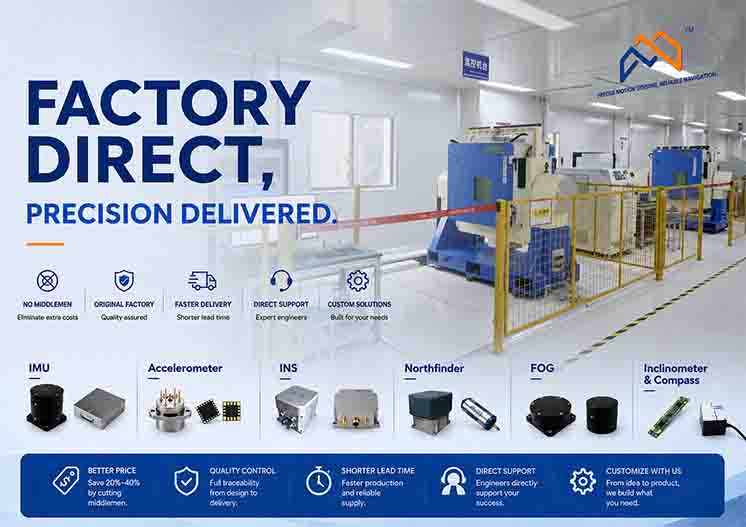
Inertial sensor original manufacturers—operating under the IDM (Integrated Device Manufacturer) model, which entails in-house R&D and manufacturing—realize a "full-link" advantage. This advantage represents not merely a closed loop in technical methodology, but a profound transformation spanning from foundational technology to commercial returns. Specifically, this is manifested in the following five aspects: I. Comprehensive Strategic Advantages The full-link advantage inherent in an original manufacturer's in-house R&D and production is demonstrated by its autonomous and controllable command over the entire process—from chip design, fabrication, and packaging to testing—thereby fundamentally guaranteeing supply chain security. Building upon this foundation, R&D teams can engage in vertical collaboration to accelerate technological iteration and integration; for instance, Maxinmin Micro’s inertial sensors have achieved a high degree of single-chip integration encompassing sensing, computation, and security functions, thereby meeting rigorous functional safety standards. Ultimately, this deep level of control enables the enterprise to precisely grasp market demands, offer differentiated products, and respond rapidly to both domestic and international clients, thereby establishing powerful competitive strength in the realm of domestic substitution. II. Core Technology and Product Performance Advantages The full-link closed loop inherent in an original manufacturer's in-house R&D and production fundamentally alters the logic behind enhancing inertial sensor performance. In traditional models, where various stages are fragmented, optimizing a single metric often comes at the expense of other performance indicators. Conversely, full-link collaboration allows for the simultaneous, system-level optimization of sensitive structures, circuitry, packaging, and algorithms; this approach not only ensures low noise and low drift but also significantly enhances stability across the full operating temperature range as well as vibration resistance. The autonomous and controllable nature of the entire process ensures that every single chip can be traced back to its specific process parameters; when combined with closed-loop feedback derived from batch testing, this capability ensures high consistency across different production batches and enables the long-term predictability and controllability of product performance. This marks a fundamental leap forward—transitioning from merely leading in "individual performance metrics" to achieving comprehensive excellence in "robustness, consistency, and predictability." III. Cost Control and Rapid Customization Advantages Full-link autonomous technology enables the enterprise to deeply integrate every stage of the process, from design through to production, thereby conferring two core advantages: First, Rapid Customization—the R&D team can flexibly adjust product specifications, performance parameters, and even packaging formats in accordance with specific client requirements, completing the development and delivery of customized products within extremely short timeframes without being constrained by the procedural limitations of external suppliers. Second, Ultimate Cost Control—by vertically integrating and eliminating intermediate links within the industry chain, and by continuously optimizing yield rates and efficiency throughout the entire process, the enterprise can minimize production costs while simultaneously guaranteeing high performance; this ensures that even customized products can benefit from the cost advantages typically associated with mass production. This capability—characterized by "on-demand customization and controllable costs"—is precisely what distinguishes full-link autonomous technology from traditional models. IV. Advantages in Supply Chain Security and Autonomous Control The full-link advantage ensures that critical core components no longer rely on imports, thereby fundamentally mitigating "choke-point" risks and safeguarding national defense and infrastructure security. Through independent innovation, enterprises can construct a "patent wall" of core technologies, establishing a comprehensive and dense intellectual property portfolio. Building upon this foundation, they can—starting from the top-level design phase—formulate supply chain management processes that adhere to the highest security standards, while simultaneously securing certifications for full localization and autonomous control from authoritative bodies. Furthermore, this approach enables the comprehensive lifecycle management and optimization of products—spanning design, verification, production, and improvement—thereby ensuring that the entire process remains under autonomous control. V. Advantages in Application Coverage and Ecosystem Empowerment Leveraging its full-link autonomous technology, Maixinminwei’s inertial sensor products systematically cover a spectrum of high-end application scenarios, ranging from industrial-grade to tactical-grade and navigation-grade levels. In the industrial and infrastructure sectors, these products are widely deployed in applications such as high-speed rail and bridge monitoring, industrial equipment condition monitoring, and structural health monitoring, meeting stringent requirements for long-term reliability and adaptability to harsh environments. In tactical-grade applications, the company provides high-precision attitude sensing and motion control capabilities for platforms including drones, unmanned ground vehicles, unmanned surface and underwater vessels, and various robotic systems. In navigation-grade applications, the products satisfy the operational stability requirements of high-reliability, high-dynamic environments—such as those involving low-earth orbit satellites, microsatellites, drone swarms, aerospace systems, and defense equipment. Moreover, the company offers a "Sensor + Algorithm + Application Solution" one-stop service, significantly lowering the barrier to entry for customers. This service also allows for the rapid customization of products based on specific requirements, thereby delivering precisely tailored, high-end inertial sensing solutions to customers across diverse sectors and operational tiers. Conclusion The full-link advantage—characterized by in-house R&D and manufacturing—fundamentally represents a restructuring of the entire value chain. It marks a transition from passively embedding within foreign technology ecosystems to autonomously defining standards, controlling costs, and driving iterative innovation. This strategic shift enables the enterprise to simultaneously ensure supply chain security while driving down the cost of high-performance sensors to a critical threshold—the point at which mass adoption becomes economically viable. In doing so, it paves the way for the large-scale application of high-end inertial sensors in strategic, cutting-edge fields such as aerospace, defense equipment, and deep-sea exploration.
Read More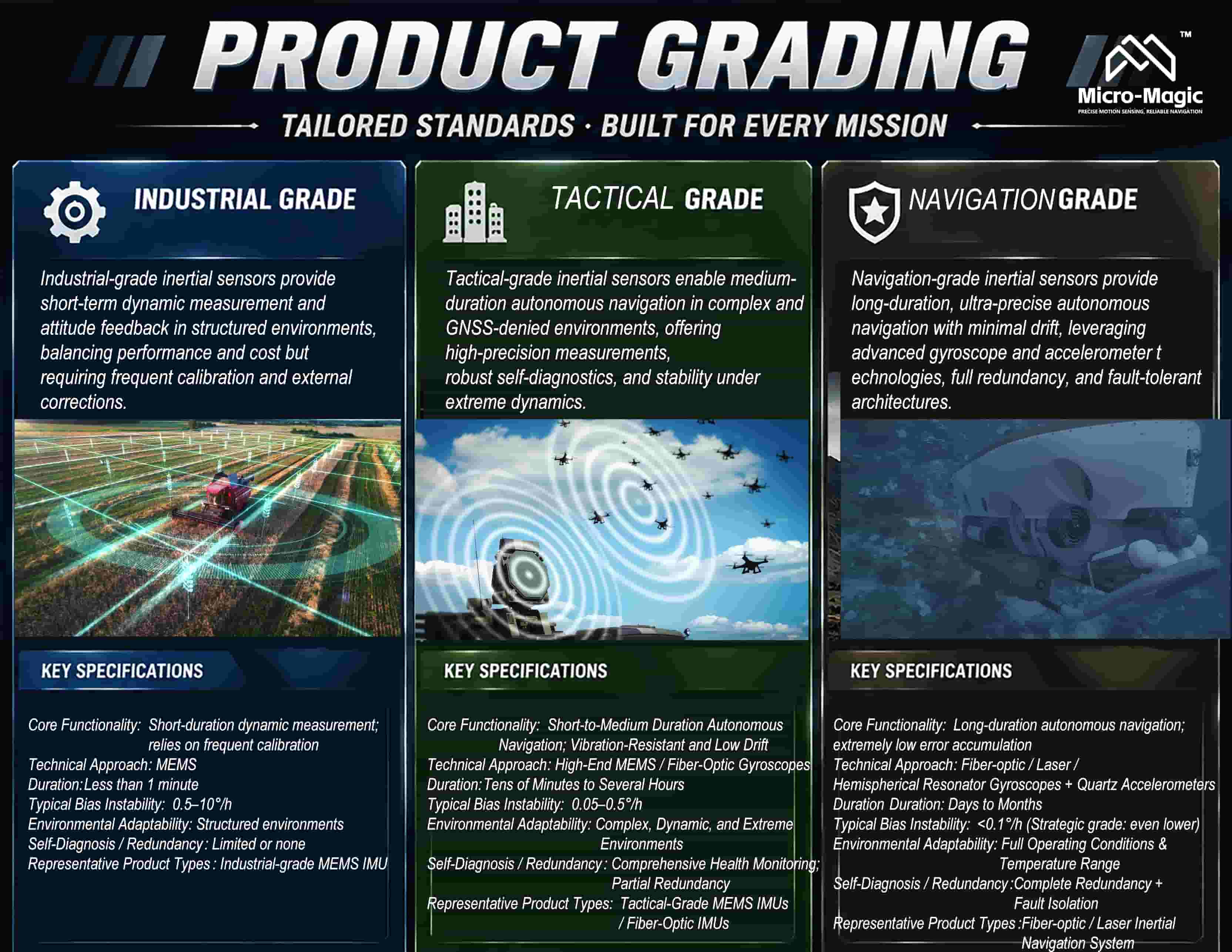
The classification of inertial sensors is, in essence, determined by the duration for which they can maintain autonomous inertial navigation accuracy in the absence of external corrections (such as GNSS). Different grades correspond to distinct hardware architectures, signal processing algorithms, and application scenarios. The following analysis deconstructs the functional characteristics of three specific grades—industrial, tactical, and navigation—across four key dimensions: functional positioning, core technologies, typical performance metrics, and applicable scenarios. 1. Industrial-grade Inertial Sensor Functional Positioning: Provides short-duration dynamic measurement and attitude feedback within structured environments. It typically relies on external sensors (GPS, vision, LiDAR) for frequent calibration to maintain system accuracy. The industrial grade functions as a "calibration-dependent" sensor. Key Technologies: Most industrial-grade inertial sensors utilize MEMS technology, featuring silicon micromechanical structures and capacitive sensing. Static calibration—including zero bias, scale factor, and axis alignment—is performed prior to shipment. Select mid-to-high-end products feature full-temperature compensation (ranging from -40°C to 85°C), as well as digital interfaces (such as SPI, I²C, CAN, RS232, RS422, etc.) and integrated filtering. Typical Performance: Industrial-grade Inertial Sensors—Gyro Bias Instability: 0.5°/h to 10°/h; Accelerometer Bias Instability: 10 μg to 1000 μg; Angular Random Walk: 0.2°/√h to 0.5°/√h; Pure Inertial Navigation Duration: Less than 1 minute (requires frequent correction). Functional Breakdown: Industrial-grade inertial sensors output raw angular rates and acceleration (IMU), fused attitude angles (AHRS), or position and velocity information (GNSS/INS integrated navigation systems). Signal conditioning circuitry performs preliminary noise suppression; some products feature built-in digital filters with configurable bandwidth. Self-diagnostic capabilities are limited, and redundancy designs are typically absent. Typical Applications: The industrial grade represents the most widely adopted classification currently utilized in the fields of robotics, autonomous driving, and industrial automation, emphasizing a balance between performance and cost. Specific applications include: attitude control for industrial robot arms and end-effector positioning (attitude accuracy of 0.1°, end-effector positioning accuracy of ±0.3 mm); indoor navigation and dead reckoning for AGVs and AMRs (with a zero-bias drift of 1.5–6°/h, meeting basic mobility requirements); flight attitude control for plant protection drones in precision agriculture (attitude accuracy of 0.1°, resulting in a >15% improvement in spray uniformity); and stabilization platform applications, such as camera gimbals and antenna stabilization (with a jitter amplitude of <0.02°). 2. Tactical-grade Inertial Sensors Functional Positioning: To provide medium-duration autonomous navigation capabilities within complex, dynamic, and extreme environments. It is capable of maintaining acceptable navigation accuracy even if GNSS signals are lost for periods ranging from tens of minutes to several hours. The tactical grade serves as the core implementer of "short-to-medium-duration autonomous navigation." Key Technologies: Tactical-grade inertial sensors employ high-performance MEMS or Fiber Optic Gyroscope (FOG) technology. They feature full-temperature-range dynamic compensation (-40°C to +85°C, or even wider), with each individual sensor utilizing its own independent compensation formula. They incorporate structural designs for vibration suppression (utilizing vibration-absorbing materials and sealed enclosures) or employ algorithmic compensation techniques. High-precision inter-axis alignment is utilized (with an error margin of less than ±0.05°), and the units feature built-in self-diagnostic and health monitoring capabilities. Typical Performance: For tactical-grade inertial sensors, typical performance specifications include: Gyroscope Bias Instability of 0.05°/h to 0.5°/h; Accelerometer Bias Instability of 1 μg to 10 μg; and Angle Random Walk of 0.05°/√h to 0.15°/√h. Pure inertial navigation can be sustained for durations ranging from several tens of minutes up to several hours. Functional Breakdown: Tactical-grade inertial sensors output stabilized angular rates and accelerations that have undergone both temperature compensation and vibration suppression. They can provide fused attitude angles (AHRS) or integrated navigation data. They support high-frequency output (≥200 Hz) to meet the demands of high-dynamic response scenarios. Comprehensive self-diagnostic functions are included to flag sensor anomalies or instances where performance thresholds have been exceeded; furthermore, some tactical-grade IMUs feature redundant sensors or dual-backup designs. Typical Applications: Missile Guidance (flight durations of tens of seconds to several minutes; a bias instability of 0.1–1°/h is sufficient); Rocket/Artillery Shell Guidance (high-G overload environments, requiring tactical-grade MEMS sensors); L4+ Autonomous Driving (GPS-denied scenarios such as tunnels or urban canyons, achieving a position error of <0.8 meters after 60 seconds); Military UAVs (medium-to-high altitude reconnaissance flights, achieving attitude control precision of 0.01° and a 25% improvement in reconnaissance image resolution); Satellite-on-the-Move (SOTM) Antennas (maintaining stable satellite signal reception while in motion); and Counter-UAS (C-UAS) Systems (enabling rapid target acquisition and tracking). 3. Navigation-grade inertial sensors Functional Positioning: To achieve high-precision autonomous navigation over extended periods without external correction. Errors accumulate slowly over time (approximating linear growth) rather than diverging abruptly. The "navigation grade" represents the cornerstone of "long-duration, unaided navigation." Key Technologies: Navigation-grade inertial sensors are centered around Fiber Optic Gyroscopes (FOG), Ring Laser Gyroscopes (RLG), or Hemispherical Resonator Gyroscopes (HRG); accelerometers typically utilize Quartz Flexure Accelerometers (Q-Flex), characterized by extremely low noise levels. These systems feature ultra-low random noise designs, with Allan variance curves approaching theoretical limits. They undergo precise calibration and compensation across their full operating temperature range and full measurement scale, achieving inter-axis orthogonality at the arc-second level. Furthermore, they incorporate multi-redundant architectures and fault isolation capabilities. Typical Performance: For navigation-grade inertial sensors: Gyro bias instability is <0.1°/h (strategic-grade units can reach as low as 0.0001°/h); accelerometer bias instability ranges from 1 μg to 10 μg (high-end units can be <1 μg); Angle Random Walk (ARW) is <0.03°/√h (high-end units can reach as low as 0.005°/√h); and the sustainment duration for pure inertial navigation ranges from several days to several months. Functional Breakdown: Navigation-grade inertial sensors output exceptionally clean angular rate and acceleration data, virtually free from thermal drift and random noise. They feature internally integrated high-precision analog-to-digital conversion and high-speed digital signal processing circuitry. They support multi-sensor redundancy management, ensuring that a single point of failure does not compromise overall navigation integrity. Additionally, they can output specific force information—precisely compensated using gravity models—to facilitate tight coupling with external high-precision sensors, such as star trackers and Doppler velocimeters. Typical Applications: Long-duration, unaided navigation for nuclear submarines and strategic bombers; inertial guidance for Intercontinental Ballistic Missiles (ICBMs); attitude and orbit control for spacecraft and satellites; long-range Unmanned Underwater Vehicles (UUVs); and high-precision gravimetric mapping and north-finding. Summary Comparison Table Functional Dimensions Industrial Grade Tactical Grade Navigation Grade Core Functionality Short-duration dynamic measurement; relies on frequent calibration Short-to-Medium Duration Autonomous Navigation; Vibration-Resistant and Low Drift Long-duration autonomous navigation; extremely low error accumulation Technical Approach MEMS High-End MEMS / Fiber-Optic Gyroscopes Fiber-optic / Laser / Hemispherical Resonator Gyroscopes + Quartz Accelerometers Duration Less than 1 minute Tens of Minutes to Several Hours Duration: Days to Months Typical Bias Instability 0.5–10°/h 0.05–0.5°/h <0.1°/h (Strategic grade: even lower) Environmental Adaptability Structured environments Complex, Dynamic, and Extreme Environments Full Operating Conditions & Temperature Range Self-Diagnosis / Redundancy Limited or none Comprehensive Health Monitoring; Partial Redundancy Complete Redundancy + Fault Isolation Representative Product Types Industrial-grade MEMS IMU Tactical-Grade MEMS IMUs / Fiber-Optic IMUs Fiber-optic / Laser Inertial Navigation System
Read More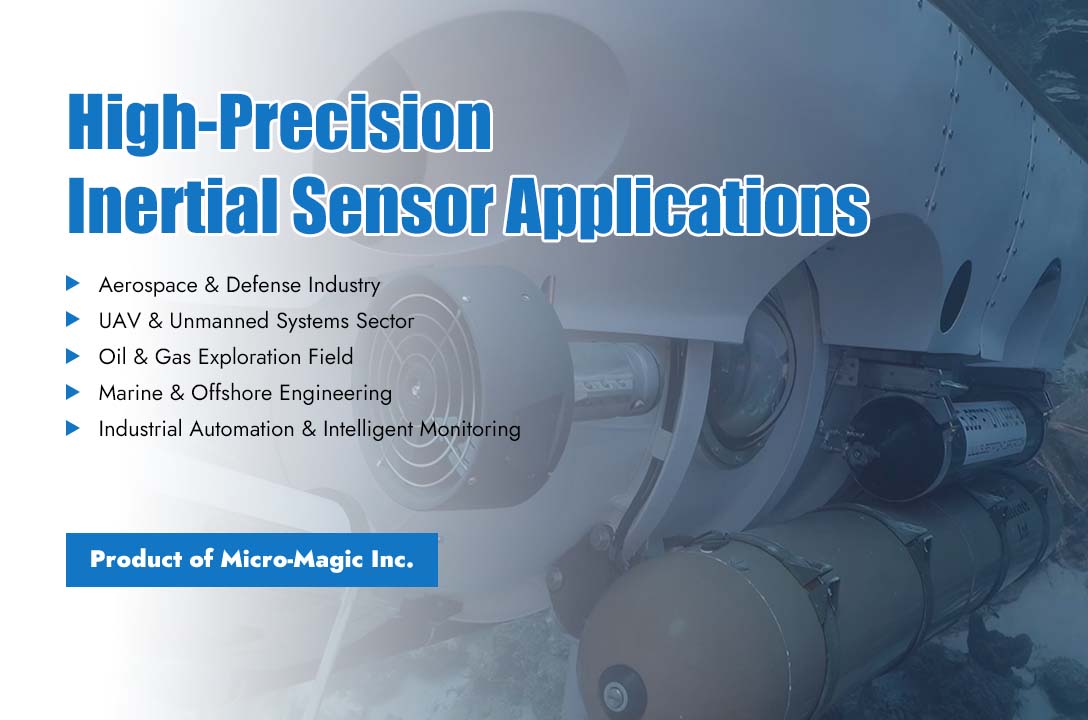
As a vertically integrated original manufacturer of inertial sensing technology, Micro-Magic Inc has built a comprehensive industrial layout covering aerospace, unmanned aerial vehicles (UAVs), oil and gas exploration, marine engineering, and industrial automation. Leveraging self-developed fiber optic gyroscopes, quartz flexure accelerometers, MEMS magnetometers, and multi-grade inertial navigation systems, the company provides customized high-precision sensing solutions for diversified harsh and high-standard industrial scenarios. With verified technical validation and mass delivery experience across global industries, Micro-Magic has formed a mature application ecosystem that adapts to extreme temperatures, intense vibration, high shock, and long-duration uninterrupted operation, consolidating its leading position in the high-end inertial measurement industry. 1. Aerospace & Defense Industry Micro-Magic Inc delivers navigation-grade and tactical-grade inertial products tailored for aerospace and defense scenarios with stringent precision and reliability requirements. The company’s high-performance fiber optic gyroscopes and temperature-resistant quartz accelerometers serve as core attitude measurement components for aviation equipment, providing stable angular velocity and acceleration data for flight attitude control, azimuth positioning, and gyro north-finding systems. All aerospace-grade products undergo strict high-low temperature circulation, anti-shock, and anti-vibration calibration in the in-house laboratory, adapting to drastic air pressure and temperature changes during high-altitude flight. The self-calibration electronic compass series further enhances heading accuracy for aerospace carriers, supporting long-endurance autonomous navigation without external signal assistance, which is widely applied in aviation attitude monitoring and defense-level positioning systems. 2. UAV & Unmanned Systems Sector Focusing on the booming unmanned system market, Micro-Magic launches optimized MEMS IMUs and lightweight inertial modules for industrial and tactical UAVs. Different from consumer-grade low-precision sensors, the company’s UAV-dedicated inertial products feature low drift, high dynamic response, and compact integration structure, perfectly matching the lightweight and high-maneuverability characteristics of unmanned aerial vehicles. These products provide real-time attitude, angle, and displacement data for aerial surveying, inspection, and industrial unmanned drones, realizing stable hovering, fixed-point navigation, and intelligent obstacle avoidance. Benefiting from independent algorithm optimization, Micro-Magic’s UAV sensors effectively suppress cumulative errors during long-term flight, ensuring continuous and reliable positioning performance for commercial and industrial unmanned aerial systems. 3. Oil & Gas Exploration Field Against the backdrop of harsh underground exploration environments, Micro-Magic has developed extreme-environment-resistant inertial sensing products represented by the AC-6 high-precision quartz flexure accelerometer. Designed for oil drilling and geological exploration scenarios, the AC-6 series withstands extreme temperatures up to 180°C and ultra-high shock impact of 1000g, with a wide bandwidth ranging from 800Hz to 2500Hz. It accurately captures underground attitude data during drilling operations, assisting engineers in well trajectory monitoring and geological parameter analysis. Combined with high-stability inertial measurement modules, the company’s products solve technical pain points such as high temperature interference and vibration signal distortion in petroleum exploration, providing reliable data support for resource exploitation, geological monitoring, and downhole attitude positioning. 4. Marine & Offshore Engineering Micro-Magic supplies professional marine-grade inertial sensing systems for offshore exploration, subsea mapping, and marine vessel navigation. The company’s fiber optic gyroscope north finders and waterproof inertial navigation modules adapt to high humidity, salt corrosion, and turbulent water flow in marine environments. These products deliver high-precision true north positioning and real-time attitude feedback for offshore operating platforms, unmanned underwater vehicles, and marine surveying vessels. With excellent long-term stability and anti-interference capability, Micro-Magic’s marine sensors effectively reduce navigation errors caused by ocean current fluctuations, supporting marine resource exploration, underwater topographic mapping, and maritime safety monitoring projects. 5. Industrial Automation & Intelligent Monitoring For industrial automation and intelligent equipment monitoring, Micro-Magic launches the ACM1000 intelligent vibration sensor and industrial-grade MEMS inertial modules. The ACM1000 sensor achieves ultra-high measurement accuracy with displacement precision of ±0.001mm and angular velocity accuracy of ±0.001°/s, capable of synchronous output of speed, displacement, frequency, and temperature data. Featuring ultra-high shock resistance of 20000g and an MTBF exceeding 45000 hours, this product adapts to long-term uninterrupted operation of industrial equipment. Compatible with diversified communication protocols including RS485, RS232, and CAN, it is widely used for mechanical vibration monitoring, equipment fault early warning, and automated production line attitude calibration, ensuring operational safety and intelligent management of industrial facilities. In conclusion, relying on independent R&D, in-house manufacturing, and a fully controlled supply chain, Micro-Magic Inc has completed full coverage of high-value industries from civil industrial automation to high-end aerospace defense. By continuously iterating quartz accelerometers, fiber optic gyroscopes, and MEMS sensing products, the company tailors targeted inertial measurement solutions for different extreme working conditions, forming unique industrial competitive advantages. In the future, Micro-Magic will continue to deepen its global industrial layout, empowering intelligent upgrading and high-precision measurement of various industries with reliable inertial sensing technology.
Read Moreleave a message
Scan to Wechat :